Dr. David Carlbom, MD at the Jack Straw Cultural Center, 2015, photo credit: Josephine Ensign
Dr. Carlbom is the Medical Director, Harborview Respiratory Care Department, and Associate Professor, Division of Pulmonary, Critical Care and Sleep Medicine. One of his mentors was the late Dr. Michael Copass at the Emergency Department, Harborview Medical Center. Dr. Carlbom spoke with me about his medical work. I was struck by the depth of his compassion and insight into not only emergency/intensive care for patients from all walks of life, but also teaching medical residents and paramedics. Please listen to his powerful stories.
Mary Pilgrim, July 22, 2015, Jack Straw Cultural Center. Photo by Josephine Ensign
Happy end of National Nurses Week with this year’s theme of “The Power of Nurses.” Last year, I highlighted some of the nurses I have interviewed for my Skid Road project. Today, I highlight an interview with a stalwart nurse, Mary Pilgrim, who ran Harborview Medical Center’s nurse clinic at the main homeless shelter at the Downtown Emergency Service Center in Pioneer Square, Seattle. When I interviewed her a the Jack Straw Cultural Center on July 22, 2015, Mary had been a nurse for 42 years and was nearing retirement. Listen to what she had to say about her work and perspective on homelessness in our city and country.
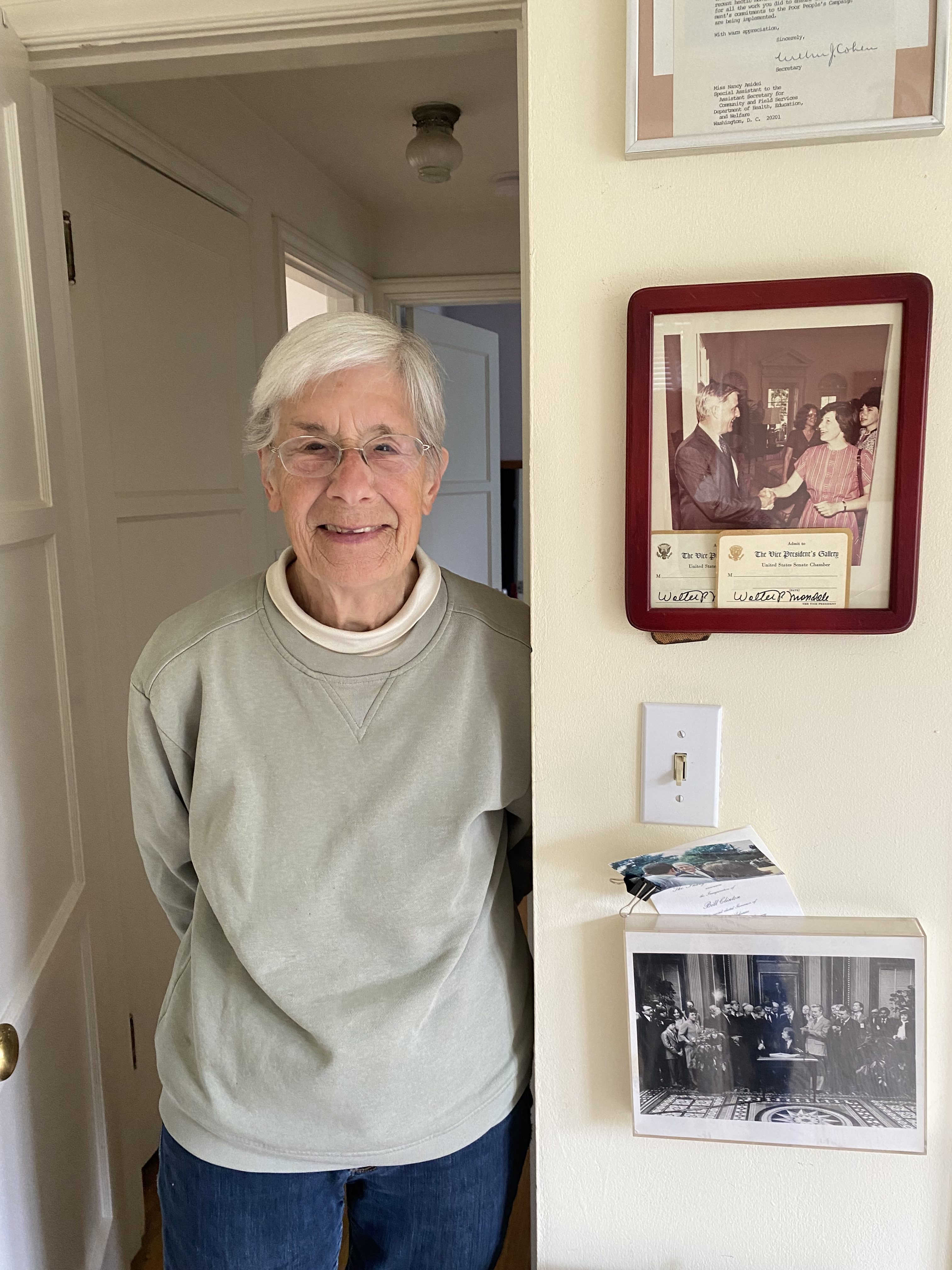
We’ve lost another great pillar of wisdom, strength, inspiration, and leadership. Nancy Amidei spent her life as a public servant, teacher, and social worker advocating for food, housing, and public health justice. From ‘saving brain cells’ through her work helping defeat Reagan’s attempt to make ketchup a vegetable in school lunches, through thousands of classes and workshops (and one book) on Advocacy 101, enticing young people to monthly meetings of the Partnership for Youth by bringing bags of chocolate (and bananas), organizing a ‘save public health’ Seattle group during the Great Recession–the only time I ever heard her tell us that she was pessimistic), to her wildly engaging and instructive ‘butter as votes’ story–oh how we admire and miss her.
I’ve already written about how and why Nancy motivated me to move across the country in 1994 to live and work in Seattle, a decision I’ve never regretted. I got to know and work with Nancy for over thirty years. I hope I have absorbed some of her passion, drive, and commitment to doing what’s right. I cannot remember why I took this photograph, but it is representative of the good feeling of having Nancy looking over my shoulder. Here is the podcast of my oral history interview with Nancy. We all have work to do…
Rep Frank Chopp, May 16, 2022. Photo credit: Josephine Ensign
“Where’s the greatest need?” Frank Chopp said he constantly asked himself during his lifetime as a health, housing, and social care advocate, first in direct services in Seattle and then as our longest-term Speaker of the House in Olympia. From starting some of Seattle’s earliest social housing programs, advocating for Apple Health for Kids, the Apple Health and Homes Initiative, behavioral health initiatives,Home and Hope, the Doorway Project, to new projects he was working on up until his death yesterday, Frank Chopp was a force of good in this world. As Frank said to me in my interview with him in 2022, “It’s the right thing to do.” I was fortunate to have worked with him on the Doorway Project and the Apple Health and Homes Project. I saw firsthand just how masterful Frank was at working across differences to help make policies and programs that “help the unfortunate,” that help build healthy, thriving communities for us all. We need more people, more politicians, more true public servants like him. Frank, you are sorely missed.
“What is going on in our society, and what ways can we change what’s happening?” Lois Thetford asked this in 1970 when she moved to Seattle and worked on grassroots community organizing–something she continues to do in her 80s. Questions that are as pertinent and urgent today as they were then.
I’ve had the pleasure of working with Lois since 1995 when I met her when I began working at what was then the independent 45th Street Clinic in Seattle. She is a mentor and an inspiration. We can all use positive change agents in our lives and in our communities. Listen to her story and her perspectives and be thankful there are people like her in our country.
Back to basics. Back to what we know works. That is my main takeaway from my interview with social worker Charlotte Tucker Sanders. I’ve had the privilege to work with her, first at Neighborcare’s 45th Street Homeless Youth Clinic and then when I led the UW’s Doorway Project. She said, “I feel like if we were to really think about this world which seems to be driven by money, and the costs and benefits. And if we were to really look at our system and not have it based on that (…) That if we keep people healthy, in the long run, we wouldn’t be spending so much money on other issues related to unhealthy people. If we were to feed people, if we were to give people their basic needs, if we made sure that everyone had enough to live on, we probably wouldn’t be so consumed with issues of violence, issues of homelessness (…) So I guess that would be my dream, that we would eventually recognize that meeting basic human needs, basic needs, would be good for everyone.”
” ‘The last thing you own when you’re losing everything you own is probably your vehicle, so that becomes your home.’ Jenn Adams knows this from six years living in her Seattle van starting in 2007. ‘I’ve lived in three different vans and a doorway,’ she said in a recent interview I had with her. She talked about her experience and current work as an advocate and peer outreach worker to vehicle residents in Seattle.
I had my own experience resorting to living in my car and in an abandoned shed for six months in my hometown of Richmond, Virginia, when I was a young adult. The topic of vehicle residency as a unique form of homelessness has long been of interest to me. I wanted to explore more of the nuances of vehicle residency from the perspective of a woman with a much longer experience than me and one based here in Seattle.”
The above passages are from my new book, Way Home: Journeys Through Homelessness, in a chapter titled “Roll On.” This chapter draws from my interview with Jenn Adams. Make sure to listen until the end for her powerful words, which literally left me speechless.
Anitra Freeman is a force of nature with an infectious laugh and a sense of humor. Freeman is a wise elder, a Raging Granny, a founding member of the Women in Black in Seattle, a housing/homelessness activist, a wife, and a computer wiz. Freeman also lives with a form of bipolar disorder and experienced homelessness in Seattle. She is now stably housed and continuously giving back to our community and working to make our city a safer, healthier place for everyone, including people without homes.
Her story is an inspiration. I have included my oral history interview here. I wrote a chapter of my Way Home book on Anitra Freeman. Freeman says, “I have often said that people have personal problems, of course, but personal problems don’t cause homelessness. Personal problems don’t dig the hole in the sidewalk; they just influence who is going to fall into it. It’s systemic factors that create the hole.”
Although only 1% of Seattle’s population identifies as Indigenous, “hundreds of years of colonization, systemic racism, broken treaties, forced reservations, and more have resulted in native peoples making up a startling 15% of Seattle’s homeless population,” as well as 32% of people experiencing chronic homelessness (quote from the Chief Seattle website). Yet we have important Native-led organizations like the Chief Seattle Club coming up with innovative, culturally relevant health, housing, and social programs to reduce homelessness for our Indigenous community members.
Derrick Belgarde, who is Siletz and Chippewa-Cree, is the executive director of the Chief Seattle Club. He has lived experience of homelessness on the streets of Seattle. Leading the Chief Seattle Club through the COVID-19 pandemic and into its current expansion of services, including permanent supportive housing, Belgarde shared his insights and experiences with me. There’s so much good stuff within this interview that I hope you listen to it in its entirety.
Focusing on the story of the police killing of the Indigenous woodcarver living in homelessness and in permanent supportive housing, John T. Williams, I wrote a chapter, “Displaced,” in my forthcoming book Way Home: Journeys Through Homelessness. It was one of the more emotionally challenging chapters to write. In the chapter, I include content from my oral history interview with Derrick Belgarde. In addition, Belgarde graciously agreed to read, comment on, and suggest changes to the chapter. As a non-Native person, I wanted to honor the stories of people like Williams and Belgarde.