Becoming a Nurse: The Events

becominganurseThis week Jane Gross in the NYT wrote a nice review of the new book I Wasn’t Strong Like This When I Started Out: True Stories of Becoming a Nurse, edited by Lee Gutkind (In Fact Books, 2013). The title of the book review is  ‘Semi-invisible’ Sources of Strength, referring to the fact that nurses are often the un-sung, un-heard, un-seen cast members in the grand drama that is modern medicine. Semi-invisible sources of strength: I suppose then that nurses are to health care what the backbone is to the human body? Lumpy and bumpy, semi-visible through the skin, at times painful? OK, I’ll stop with the analogy.

In the days following the NYT book review, True Stories of Becoming a Nurse quickly became one of their top sellers. In the past day it has been in the top 20 on Amazon. Fascinating to see the book filed under “healing,” “spirituality,” and “personal transformation,” as if it belongs in Whole Foods next to the crystals and incense and socks made of recycled bamboo. Thanks Jane Gross for writing the review and thanks NYT for including it. That Ms. Gross focused her review on the old old and seriously tiresome rift between diploma-trained and university-educated nurses in tertiary care settings is unfortunate—but understandable given that she was writing the review as a testament to her diploma-trained RN mother. I get it; I’ll move on to more important topics.

Our University of Washington (with support from 4Culture)-sponsored Becoming a Nurse book launch on April 18th at Suzzallo Library in Seattle was a great success. We had a total of five nurse author panelists who read from their anthology essays. Many, many thanks to the four panelists (Kim Condon, Eddie Leuken, Lori Mulvihill, and Karla Theilen) who paid their own way out here to attend the event. I only had to ride my bike two miles in the rain to get to the event—several of the other panelists flew in from across the country). Many, many thanks as well to the mighty team of UW Health Science librarians (Tania Bardyn, Lisa Oberg, Joanne Rich, and Janet Schnall) for organizing, hosting, and recording the event. The video recording of the readings is here . Note that the audio quality is much better than the video but you can see our general shapes as we read!. You can’t see the wonderful audience but they packed the room—standing room only. Thanks all you supportive audience members!

In case you missed the UW Suzzallo Library Becoming a Nurse event, we will have another Becoming a Nurse reading next month (Tuesday June 11th, 7pm) at Elliott Bay Book Company in Seattle. I will be reading along with Eddie Leuken and Karla Theilen). All three of us will read excerpts from our anthology essays, as well as new work.

This Friday (May 24th) at 6:30pm I’ll be reading at the Northwest Folk Life Festival in Seattle as part of the 2013 Jack Straw Writers Program. (6:30-7:30pm SIFF Cinema/Narrative Stage). Kathleen Flenniken, poet laureate of Washington State will be the host/KUOW sponsors the event. I’ll be reading from new work from my collection of poetry and prose I’m working on called Soul Stories: the stories feet can tell about the journey of homelessness. In the essay I’ll read I ask myself (and partially answer) the questions: why am I drawn to the suffering of others? Why have I spent the past thirty years working as a nurse with homeless and marginalized people? Wouldn’t I be happier if I was drawn to work as a shoe buyer for Saks Fifth Avenue? Questions I am sure many nurses and others in helping professions ask themselves.

 ___________________________________________________

The following is the press release for the book.

I Wasn’t Strong Like This When I Started Out: True Stories of Becoming a Nurse
Edited by Lee Gutkind
Featuring new work by Theresa Brown, Tilda Shalof, and others.


As editor Lee Gutkind points out in the introduction to I Wasn’t Strong Like This When I Started Out, “there are over 2.7 million working RNs in the United States (not to mention our many LPNs and LVNs), compared to about 690,000 physicians and surgeons. There are more nurses in the United States than engineers … or accountants and auditors … And, yet, many of us take the work these men and women do for granted.”


This collection of true narratives captures the dynamism and diversity of nurses, who provide the vital first line of patient care. Here, nurses remember their first “sticks,” first births, and first deaths, and reflect on what gets them through long demanding shifts, and keeps them in the profession. The stories reveal many voices from nurses at different stages of their careers: One nurse-in-training longs to be trusted with more “important” procedures, while another questions her ability to care for nursing home residents. An efficient young emergency room nurse finds his life and career irrevocably changed by a car accident. A nurse practitioner wonders whether she has violated professional boundaries in her care for a homeless man with AIDS, and a home care case manager is the sole attendee at a funeral for one of her patients. What connects these stories is the passion and strength of the writers, who struggle against burnout and bureaucracy to serve their patients with skill, empathy, and strength.
Pub. Date: March 2013, ISBN: 978-0-393-07156-6, 5 ½ x 8 ¼, Trade Paper, 278 pages,
$15.95, Distributed by Publishers Group West


Lee Gutkind has explored the world of medicine, technology and science through writing for more than 25 years. He is the author of 15 books, including Many Sleepless Nights: The World of Organ Transplantation, and the editor of five anthologies about health and medicine, including At the End of Life: True Stories About How We Die.

In Fact Books is a new imprint founded and edited by Lee Gutkind, editor and founder of Creative Nonfiction. In Fact Books titles help create an understanding of our world through thoughtful, engaging narratives on a wide variety of topics and real-life experiences. All titles are distributed by Publishers Group West. For more information, please visit http://www.infactbooks.com.
For interview requests and other media related questions, please contact:
Hattie Fletcher at fletcher@creativenonfiction.org or (412) 688-0304.


Southern Sin

IMG_0935I am immersed in the land of the Delta Blues, soaking up the stale fried grease smells (they really do deep fry everything—peanuts, pies, pickles, pork rind), humidity, wafts of tobacco smoke, waves of whisky breath, and the amazing deep Southern drawls. Here in Tupelo and Oxford Mississippi I have been contemplating Southern Sin in all its permutations. On the plane ride from Seattle I read through the newest edition of Creative Nonfiction’s special edition, Southern Sin. Not surprisingly, many of the essays deal with sex. It probably isn’t a surprise that the Bible Belt of Mississippi has the highest per capita number of Christian churches (mostly Southern Baptist), and also has the highest per capita number of sexually transmitted infections of any state in the U.S. It is no surprise that Mississippi is the fattest state. It did surprise me that Mississippi has our country’s highest casino market, concentrated along the Mississippi River. Life expectancies are the worst in Mississippi. But something that has really struck me while here is how worn out and unhealthy the poorer white women look. Many of these women I’ve encountered have been working in gas stations or in diner-type places—low-wage service jobs—so I assume they do not have much education. For me they are now the ‘face’ to the dry statistics showing the stark decline in life expectancy for white Southern women without a high school education. Recent studies show that for this group of women life expectancy has fallen by five years since 1990. Nationally, life expectancy for white women without a high school education was 73.5 years, vs. a life expectancy of 83.9 years for white women with a college degree. Researchers are mostly perplexed by the life expectancy declines for disadvantaged white women, but guess that higher stress levels, smoking, obesity, and misuse of alcohol and prescription pain medications are contributors.

Sources:

Life Expectancy Shrinks for Least-educated Whites in U.S., NYT, Sept 20, 2012/ Sabrina Tavernise.

One Nation, Seven Sins. Las Vegas Sun, March 26, 2009/Abigail Goldman.


Fat Phobia

Obesity Campaign Poster
Obesity Campaign Poster (Photo credit: Pressbound)

Maybe it is the fact that swimsuit and shorts season is fast
approaching for many of us in the non-tropical parts of North America. Or maybe it’s just that I’m facing yet another round of reading and grading nursing student papers, many of which are by students who remain fervent in their anti-obesity zeal. But there seems to be a lot of recent news articles about obesity, and about the effects of our national obsession with weight control and with our deeply entrenched fat phobia.

Upfront, I’ll admit it. I have a fat phobia. I already knew this. I was noticing how many times I included weight in my physical descriptions of people in my own writing or in my conversations with my husband. But my fat phobia seems to be a fact and not just a hunch. I just took the Fat Phobia Scale from the Rudd Center for Food Policy and Obesity at Yale University. I scored at the highest possible level of fat phobia. Although I am currently and have been for most all of my adult life, of normal weight, I was anorexic for a few years as a teenager, followed by a rebound into the overweight category for a while as a young adult. I know first-hand what it feels like to be both under and overweight, what it feels like to be in those different bodies of sorts—how people interact with you differently because of your weight. I am well aware of how stress and poverty and genetics are more powerfully connected with obesity than are the commonly perceived individual character flaws of gluttony and laziness. I am also aware of the recent research on the “obesity paradox” indicating that obesity may not be as bad for a person’s overall health as we have been taught to believe. (see NYT article Obesity Paradox: Thinner May Mean Sicker, by Harriet Brown, 9-17-12). I encourage my students to confront their own biases that can negatively affect their patient care—all the ‘isms’ we traditionally try to address, such as racism, classism, heterosexism, etc. But ‘fatism’ still seems to be not only tolerated but actively encouraged within our nursing educational system. I’ve been part of that and will try to mend my ways.

Two recent NYT articles spurred my interest in this topic. One by Tara Parker-Pope, entitled Overweight Patients Face Bias (4-29-13) reports on a study at Johns Hopkins indicating that physicians showed less warmth and compassion with patients who were overweight. The second NYT article (by Jan Hoffman, 5-1-13) entitled When the Doctor is Overweight, reports that patients are less likely to trust doctors who are overweight. Studies indicate that nurses are twice as likely as physicians to be obese (and depressed), even after controlling for income and education levels (see references below). For hospital nurses obesity is often linked with job stress and sleep cycle disruptions. I imagine that the same sort of ‘fatism’ bias negatively affects patient care by nurses.

References:

Olivia Katrandjian/ABC News, Study Finds 55 Percent of Nurses are Overweight or Obese, 1-3-12.

Carolyne Krupa/American Medical News, Doctors Follow Own Advice for Healthy Living, 10-24-12.

Prairie Lights

IMG_0787A week or so ago I returned to Iowa City to attend this year’s Examined Life narrative medicine conference at the University of Iowa Carver College of Medicine. I was there two years ago for the same conference and at that time I kept asking myself why Iowa was such a center for creative writing in our country. I think I concluded that it had to do with the fact that there’s nothing else to do in Iowa City except drink, write, and watch the corn grow. I’m sure there’s more to it than that, but I have yet to discover it. Two years ago when I first visited the town, I wasn’t much impressed by the indie bookstore in town, Prairie Lights. I was being a Seattle big city snob. This time I spent more time in Prairie Lights and it began to grow on me. I adored having my soy latte served in grandmother’s flowered china alongside water served in a canning jar. The bookstore has a small-town friendly vibe and the staff people are helpful and enthusiastic about all things literary. They helped me track down, buy, and read Grantas Summer 2012 edition “Medicine,” which features Chris Adrian’s excellent short story “Grand Rounds.” Out of the sixteen authors included, only three identify as working in health care—and all three of them are male physicians. But OK, who’s counting (except me). The likes of Alice Munro are included.

I was trying to make sense of Chris Adrian’s sort of Grand Rounds keynote speech that I had just sat through at the conference. The official title of his talk was “Uselessness.”  The proposed objective of his talk was: “Participants will reflect, perhaps usefully, on their own anxieties about uselessness as artists, medical providers, humanists, and scholars.” It was a bit of a rambling speech that he read off of an ipad mini from behind a podium to a packed medical school auditorium. I tried to listen to his talk, but was often distracted by the sound of my seatmate—a NYC female physician dressed head to toe in animal print and clutching her animal print covered ipad—snoring loudly, her head falling with a thunk onto my shoulder. Discourses on existential crises will forever be labeled in my mind under the category “fake dead animals.”

There’s a point to this somewhere. To this blog post. To Chris Adrian’s University of Iowa keynote Grand Rounds speech. To the primal animal snores of my med school auditorium seatmate. To the coffee grounds left in the bottom of my Prairie Lights soy latte… Ah yes, it is that I refuse to think this is useless.

Death, taxes, and childbirth!

Cover of "Gone with the Wind"
Cover of Gone with the Wind

“There’s never any convenient time for any of them.” Thus said Scarlett O’Hara in Margaret Mitchell‘s Gone with the Wind.

I have no advice to offer on either taxes or childbirth, although I have experienced both in my life. But I do have advice on death, specifically on the importance of having Living Wills/Advance Directives. I’ve written many blog posts related to this topic, about my frustrating encounters with the healthcare system misplacing/not honoring my elderly father’s Advance Directives.

“April 16 is National Healthcare Decisions Day, and I hope that you will take this time to discuss and document your healthcare wishes.  We all need to be prepared in the event of a health crisis, and having the talk is easier than most people think, but many of us need a little inspiration or a reminder to do it.  I hope that this message and National Healthcare Decisions Day are all you need for inspiration.  Please check out the short, but fantastic video at www.nhdd.org and then mark your calendar for April 16 to have the talk with your loved ones.  There are all sorts of free resources–including free advance directive forms for each of the 50 states–on the NHDD website: http://www.nhdd.org. Additionally, please help me spread the word with Twitter, Facebook, and LinkedIn. Advance care planning is something we ALL should do and encourage others to do, regardless of age or current health.  Discussing your wishes can be one of the most important gifts you ever give your loved ones.” (from Nathan Kottkamp, Chair of the National Healthcare Decisions Day initiative.”

Related to this topic, and especially relevant to nurses, is the excellent American Journal of Nursing short essay by Doug Olsen, “Issues Raised by Media Coverage of a Nurse Declining to do CPR.”In his essay, Olsen points out the ethical issues related to media people who sensationalized the case of the ‘nurse’ in a California assisted living facility who refused to do CPR on an elderly woman resident. But he also points out the willful lack of education of the general public (by the healthcare system) about the dangers of and limits to CPR, especially in elderly patients. This is something nurses and other healthcare professionals need to do a better job with.

So listen to Scarlett: do your taxes, attend to whatever childbirths you may encounter, and talk with your loved ones about their end of life wishes.

Happy World Health Day: Don’t Pass the Salt

English: Checking the blood pressure by using ...
English: Checking the blood pressure by using a sphygmomanometer and stethoscope. (Photo credit: Wikipedia)

NYC Mayor Bloomberg is continuing his efforts to create an enabling environment for health by including sodium reduction in food in his public health campaign. Some people (and some states like Mississippi) complain that Mayor Bloomberg is creating a nanny state; others applaud his efforts. His sodium reduction efforts fit with this year’s World Health Day theme of hypertension awareness and control.

From the WHO World Health Day website http://www.who.int/world-health-day/en/:

“This World Health Day, 7 April 2013, WHO and partners focus on the global problem of high blood pressure. Though it affects more than one in three adults worldwide, it remains largely hidden. Many people do not know they have high blood pressure because it does not always cause symptoms. As a result, it leads to more than nine million deaths every year, including about half of all deaths due to heart disease and stroke.

Everyone can take five concrete steps to minimize the odds of developing high blood pressure and its adverse consequences.

  • Healthy diet:
    • promoting a healthy lifestyle with emphasis on proper nutrition for infants and young people;
    • reducing salt intake to less than 5 g of salt per day (just under a teaspoon);
    • eating five servings of fruit and vegetables a day;
    • reducing saturated and total fat intake.
  • Avoiding harmful use of alcohol i.e. limit intake to no more than one standard drink a day
  • Physical activity:
    • regular physical activity and promotion of physical activity for children and young people (at least 30 minutes a day).
    • maintaining a normal weight: every 5 kg of excess weight lost can reduce systolic blood pressure by 2 to 10 points.
  • Stopping tobacco use and exposure to tobacco products
  • Managing stress in healthy ways such as through meditation, appropriate physical exercise, and positive social contact.”

Managing stress in healthy ways. I’m thinking of how lower socioeconomic status is directly related to increased stress. Recommending meditation to poor people as a way to reduce stress sounds quite condescending, almost like the proverbial ‘let them eat cake’ thing. Exercise and positive social contact make more sense.

Heart’s Oratorio

It is Spring Break and instead of heading to warm beaches I’ve been indulging in a massive reading intensive, staying up into the wee hours of the morning IMG_0775finishing book after book as if they were bonbons. Some have been disappointing reads (like biting into a chocolate bonbon only to discover a nasty fake cherry filling): Kathryn Schulz’s Being Wrong, Ryszard Kapuscinski’s Travels With Herodotus, and Michelle Kennedy’s Without a Net). Others have been rewarding, such as Colum Toibin’s The Blackwater Lightship and Ivan Turgenev’s Fathers and Sons. But one book stands out as a keeper and worthy of future re-reads and study: Mary Oak’s Heart’s Oratorio: One Woman’s Journey through Love, Death, and Modern Medicine (Goldenston Press, 2013).

First, a disclaimer. I know Mary from my monthly writing group—the Shipping Group—that meets at my favorite bookstore, Elliott Bay Book Company. Mary is a quietly strong and centered woman. But that is not why I love her book. I love her book because it is beautifully written and tells a powerful and unique medical narrative. I love her book because it helped me to view the medical system from a different perspective.

Mary has died twice in the past decade. The first time she died was in 2007 in the Houston airport while running to catch a connecting flight to Paris. She collapsed in the airport terminal. Otherwise healthy but having asymptomatic ‘athlete’s heart,’ she experienced sudden cardiac death, then was brought back to life through the actions of emergency medical personnel and hospital treatment. Back home in Seattle, Mary underwent two cardiac surgeries at Northwest Hospital. During the second surgery, to implant a cardiac defibrillator, Mary’s heart stopped once again. But that is just the background medical drama of her story. The real story is Mary’s spiritual journey through it all. Mary comes from a long line of homeopath and Christian Science healers and had avoided most all things allopathic. But as she writes, “Nothing like sudden death to invite a different perspective.” Mary’s book is also a love story: her love and care for her children who may have inherited her cardiac condition, as well as her love of David who becomes her husband and cares for her through her illnesses.

Although I neither share Mary’s spiritual beliefs nor her long family history of spiritual healers, I was drawn into a deeper understanding of and respect for them through her story. I can envision using her book in the nursing education that I do. Many parts of Mary’s medical narrative occurred right here in Seattle in hospitals where my students are trained and may eventually work—so it is literally close to home. Mary describes walking past my own university office (in the world’s largest and ugliest university building/photo attached here) on her way to find her medical records:

“Then I walk city blocks’ worth of narrow hallways with low ceilings and polished tan vinyl floors. I pass countless numbered doors. Only one is open: to a room of legless and armless dummies on the floor for a CPR training. No one is there. As I walk past various laboratories and offices, I wonder how much debt I will incur with this latest round of medical consultations. Will I live to pay it off?”

Becoming A Nurse: Nurse Writer Panel Discussion

You are all invited/open to the public:

Becoming a Nurse

Nurse Writer Panel Discussion and Reading

Thursday April 18th 6-8:30pm

Suzzallo Library Smith Room

6-6:30 Light Refreshments

6:30-8:30 Panel Discussion, Reading, and Book Signing

I Wasn’t Strong Like This When I Started Out: True Stories of Becoming a Nurse

Edited by Lee Gutkind

In Truth Press. Pub. Date: April 2, 2013

This collection of true narratives captures the dynamism and diversity of nurses, who provide the vital first line of patient care. Here, nurses remember their first “sticks,” first births, and first deaths, and reflect on what gets them through long demanding shifts, and keeps them in the profession. The stories reveal many voices from nurses at different stages of their careers: One nurse-in training longs to be trusted with more “important” procedures, while another questions her ability to care for nursing home residents. An efficient young emergency room nurse finds his life and career irrevocably changed by a car accident. A nurse practitioner wonders whether she has violated professional boundaries in her care for a homeless man with AIDS, and a home care case manager is the sole attendee at a funeral for one of her patients. What connects these stories is the passion and strength of the writers, who struggle against burnout and bureaucracy to serve their patients with skill, empathy, and strength.

Panel will include an interview with Theresa Brown who writes for the NYT Well Blog. Participants include Josephine Ensign, DrPH, Associate Professor, Department of Psychosocial and Community Health, whose essay Next of Kin appears in the anthology.

This project was supported, in part, by an award from 4Culture  4culture_color

University of Washington Health Science Library   logo-hsl-admin-color-printer

My Week As A Chavista

OLYMPUS DIGITAL CAMERAFormer Venezuelan President Hugo Chavez is having a state funeral today, being buried in the red beret and green army uniform he came into power with fourteen years ago. He won’t really be buried. Instead, his body will be “embalmed like Lenin” and displayed in a glass case for “eternity,” perhaps in his recently built New Museum of the Revolution, or in the new $60 million Mausoleum for Simon Bolivar.

The first time I visited Venezuela was in August 1999, during Chavez’s first year of presidency. He had publicly vowed to end poverty and homelessness—a laudable if impossible goal. I spent a month in Venezuela, first in the mega-city Caracas and then in the agricultural state of Yaracuy. It was there that I found myself wearing a red shirt and being interviewed on TV and by newspaper reporters about the situation of homeless youth in the U.S. I was asked to give a public talk on reproductive health of homeless young women at the local university. My talk was sponsored by the federal Ministry of Families social services agency. The shortened title of my talk became “Infancia Abandonada,” literally translated as abandoned children. There were about fifty people in attendance, with the front two rows occupied by the Venezuelan military in their red berets and gold braid and tassels. It was an interesting cross-cultural immersion experience. Even at the time I realized I was a political pawn in the grand chess game of inter-American relations. They wanted me to highlight how a rich (and arrogant) country like ours can have such a large homeless population, including abandoned children living on our nation’s streets.

The public health and nursing schools located in Yaracuy wanted to establish research ties through me with the university in the U.S. where I work. But since their university was state-run and Chavez became increasingly anti-U.S., those research ties had to be undone. I’ve returned to Venezuela twice since my first visit. On my most recent visit in 2010, it was a vastly different country: rolling electricity blackouts, water stoppages, food shortages and rationing of even basic staples like corneal, and major roads almost impassable by lack of maintenance. There was also a palpable level of anxiety and dis-ease among the Venezuelans, especially in Caracas but also noticeable in other areas of the country I visited. The only other country I have ever been in where I felt a similar level of dis-ease was in the military-run Burma/Myanmar. While poverty levels have reportedly been lowered during Chavez’s fourteen years in office, I was left wondering who exactly was measuring this and how they were measuring it. I was left wondering if there aren’t much worse things than poverty and homelessness….

Into the Sunset

dadatbeachIn October 2010 I first wrote about the journey of my elderly father through declining health and the healthcare maze. In my blog post titled A Practical Man and Modern Medicine this is how I started his/our story:

Today on the phone, my 87-year-old father asked me to be his patient advocate. He is facing tough health care decisions over the condition of his heart, and is scheduled for surgery in a week. He is a practical man, bright, charming, and articulate, with no cognitive deficits that I can detect. He told me where his Living Will and Advanced Directives are, where he wants his body donated for medical research, and what to do when his CD matures (he’ll be in surgery) so that he can roll it over to a money market account. He says he needs access to the money for his after-hospital care, in case he survives surgery. I am thinking about the health policy issues within all of this: 1) heart failure accounts for the largest portion of Medicare expenditures, 2) none of his doctors have talked with him about what all is involved with this surgery, or what quality and quantity of life he can hope for afterward, and 3) home care provided by family members is not well supported (financially and otherwise) in our country. As his daughter and as a family member embedded in the health care system, what do I do with this information?

Almost three years later I still don’t know what to do with this information. I have discovered the healthcare system to be even more bewildering and capricious than I had imagined. I last wrote about my father this past fall in the post Transitions (October 22, 2012), when I was back in Virginia helping him survive the rough crossings between four different health care settings in six weeks—the last one being the calmest and sanest of all—home hospice. My father was weak, oxygen-dependent, and had advanced wasting from end-stage congestive heart failure. His cardiologist didn’t expect him to live much past Christmas. The day after hospice started my father used his walker to get from his hospital bed in the living room to the studio in the back of the house. Once there he strapped himself into his recumbent exercise bicycle and started “getting back into shape again.” We all thought he was nuts, but decided if he wanted to die while riding his bike off into the sunset of the studio that was his choice.

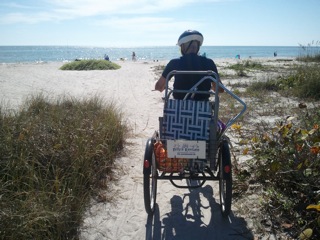
Since then he has confounded his cardiologists who say that by all objective measures my father should be so physically disabled as to be bed bound. Instead, he once again ‘graduated’ out of home hospice and as I write this he is riding his ‘real’ bicycle off into the ‘real’ sunset on a beach in Florida to meet up with friends for Happy Hour, sans alcohol for my teetotaler father. The photo to prove it was taken by my niece who is his caregiver for a few weeks.

Clearly my father’s story is not over, even though he has finished writing his memoir in barely decipherable handwriting on ten legal pads, which are in the mail to me. My father wants me to transcribe them and make into a book. “After all, this whole memoir business was your idea,” he said to me. He wants to proofread the final draft to make sure I didn’t change any of his words.

Last fall I wrote an essay titled Home Death about my experiences with the healthcare system, as I tried to uphold my role as health care advocate and proxy for my father. It was published recently in Johns Hopkins Public Health: The Magazine of the Johns Hopkins Bloomberg School of Public Health, Special Issue 2013. You can read it here.