My father died this morning. He died peacefully in his bed at home surrounded by family members, trusted caregivers, and my late mother’s artwork. This photo, which I took a few weeks ago, shows my father ‘getting his daily exercise’ doing laps inside his house using his walker, under the watchful eye of my mother (the painting is her self-portrait about her own heart disease). My father died from the effects of congestive heart failure. When he died, my father wasn’t exactly wearing his boots and gardening gloves, but very close to it. Our family harvested sweet potatoes yesterday from my father’s backyard garden.
Four years ago, when I began this Medical Margins blog, my first post was about my father’s (and our family’s) struggle to negotiate a dignified and peaceful home death for him amidst the Kafkaesque nightmare of our health care system. (See “A Practical Man and Modern Medicine” 9-26-10). I also wrote an essay about my slightly Quixotic efforts to be my father’s cross-country patient advocate and health care proxy through his countless hospitalizations and transfers in and out of nursing homes and home heath care. (See “Home Death” in The Johns Hopkins Public Health Magazine, Special Issue 2013).
During his last hospitalization (a bounce-back hospitalization after only two days at home and before hospice was finally ordered), my father was moved to six different hospital rooms on the same cardiac floor in less than a week. He became more and more distressed and disoriented with each move. He was being treated with three different antibiotics (two IV) for two different hospital-acquired infections. This was despite the fact that my father had clearly documented Advance Directives requesting none of these unnecessary ‘heroic’ measures. It took a direct plea from me to the head of cardiology to have the antibiotics discontinued and my father released to home hospice. That was only three days ago. His (nonprofit, religious-based) home hospice was terrific.
I’ve realized during this final surreal (is ‘Woolfian’ a word? it should be–it has felt very much like her writing in The Waves) month, that we have created a Frankenstein monster: ‘the creature’ or ‘the wretch’ of our health care system (especially the hospital). I’ve realized that my frustration and anger over my father’s end-of-life care is not as simple as displaced grief over losing my father. My anger can not be directed at any one physician or nurse or hospital. Rather, my anger is really dismay (bordering on despair) that I–that all of us– can have been a part of the maintenance of such a sad and broken wretch. Apart from putting all of our hospitals and nursing homes on (the melting) ice flows along with Frankenstein’s monster, what can we do to reform and redeem this creature we have created?
To the Reverend John Edward Ensign, my force-of-nature father: rest in peace.
Respond with a smile and kind words—even if it is “no—sorry” when you’re asked for a handout for coffee, a meal, or spare change. There’s nothing worse than for a person to be ignored–unless it is for them to be ridiculed, called names, told to ‘just get a job,’ or to become the victim of physical violence. Speak up if you witness someone harassing or demeaning someone who appears to be experiencing homelessness. (See ‘hate crimes and homelessness’ below.)
Carry fast food restaurant certificates to give to the homeless when they ask for food.
Support and buy Real Changeor whatever your local poverty and homelessness newspaper is. Take the time to talk with and get to know the vendor.
Support an agency that provides direct services to the homeless, especially agencies that also work on upstream solutions to preventing homelessness, such as low income housing or job training programs. An example of upstream services is Habitat for Humanity whose vision ‘is a world where everyone has a decent place to live.’ Not a shabby vision to have and to support.
Become informed and become an advocate for local community solutions to homelessness and poverty, as well as state, national, and international ones. Consider joining advocacy organizations such as the excellent National Low Income Housing Coalition.
Hate Crimes and Homelessness: There is a well-documented relationship between criminalizing homelessness (such as municipal laws against camping or panhandling) and ‘hate crimes’/violence against homeless people. Although homeless status is not currently a protected class under federal hate crime laws, there are local, state, and federal efforts to increase protection of homeless people from being victims of bias and opportunity hate crimes. People experiencing literal homelessness are very visible and vulnerable to being victims of targeted crime.
The National Coalition for the Homeless collects data on violence against homeless people. In their latest report (June 2014), Vulnerable to Hate: A Survey of Hate Crimes Against Homeless People in 2013, they found that documented cases are rising (perhaps partially–but not completely–due to better surveillance and recording efforts. Such crimes remain significantly under-reported.) This is an excellent, balanced, and disturbing report. It includes detailed case studies of victims of targeted violent hate crimes.
Last year there were 109 documented attacks on homeless people, resulting in 18 deaths. There were five documented cases of police brutality of homeless people. Over half of all cases of violence against the homeless were in California and Florida. Nationally, the vast majority of perpetrators were teenage and young adult men. In the report, they call for federal Homeless Hate Crime legislation, better reporting of homeless hate crimes, as well as education/prevention efforts such as education (enlightenment) in high schools and police departments.
Note: This series of blog posts on health and homelessness is based on my unpublished* book manuscript Catching Homelessness. It is the story of my experiences with homelessness, both as a nurse practitioner working with homeless people, and as a homeless person. The stories in Catching Homelessness are about events that have happened to me through my work with homeless people. The stories are all factual in that they actually happened. My perception of them at the time of the events and my memories of them inform the stories. Many of my interactions with people in these stories were within an ongoing professional relationship. Since I recount stories of specific patients I worked with, out of ethical and legal obligations, I have altered some biographical details and changed names in order to protect their identities. I have not changed the names of co-workers and friends except where indicated as such in the text.
I have kept detailed journals, both personal and work-related, throughout my life. These were invaluable resources for writing this book. Because I have a background and training in anthropology, my work-related journals were written as expanded field notes. In my journals I recorded patient stories, direct quotes, profiles and personality quirks of co-workers, my reflections on my actions and on events with which I was involved. I kept copies of my detailed monthly and year-end clinic statistics, narrative reports, and letters that I submitted to the Cross-Over Clinic Board of Directors, for whom I worked; these became sources of information for sections of this book. I also drew upon archived newspaper articles, mainly from The Richmond Times-Dispatch, the leading newspaper in Richmond at the time, and currently the city’s only major newspaper. For some chapters, I relied on interviews with people working with homeless people in Richmond, site visits, and reports (past and present) on homelessness in Richmond, in Virginia, as well as nationally.
The following books and articles were the ones that I referred to the most, or which most influenced my thinking as I wrote Catching Homelessness.
Zygmunt Bauman. Wasted Lives: Modernity and Its Outcasts. (Polity Press: Cambridge), 2004.
Ted Conover. Rolling Nowhere: Riding the Rails with America’s Hoboes. (Vintage Press: New York), 2001.
Kim Hopper. “Homelessness Old and New: The Matter of Definition.” In, Understanding Homelessness: new Policy and Research Perspectives, Dennis P. Culhane and Steven P. Hornburg eds., (Fannie Mae Foundation, 1997).
Kim Hopper. Reckoning With Homelessness. (Cornell University Press: Ithaca), 2003.
Joseph B. Ingle Last Rights: 13 Fatal Encounters with the State’s Justice. (Abingdon Press: Nashville). 1990.
Jonathan Kozol. Rachel and Her Children: Homeless Families in America. (Three Rivers Press: New York), 1988.
Elliot Liebow. Tell Them Who I Am: The Lives of Homeless Women. (Penguin: New York), 1993.
Elliot Liebow. Tally’s Corner: A Study of Negro Streetcorner Men. (Rowman and Littlefield Publishers: Lanham, MD), 2003.
Paul A. Lombard. Three Generations, No Imbeciles: Eugenics, the Supreme Court, and Buck vs Bell. (JHU Press, Baltimore), 2008.
George Orwell. Down and Out in Paris and London. (Harcourt: New York), 1933.
Janet Poppendieck. Sweet Charity?: Emergency Food and the End of Entitlement. (Viking: New York), 1998.
Christopher Silver, Twentieth-Century Richmond: Planning, Politics, and Race. (The University of Tennessee Press: Knoxville). 1984.
Ensign, J. (May 30, 2014) “No Place Like Home(less)” essay published in Pulse: Voices From the Heart of Medicine. Albert Einstein College of Medicine. (Reprinted on KevinMD
Ensign, J. (May 17, 2013) “On the Road” essay published in Pulse: Voices From the Heart of Medicine. Albert Einstein College of Medicine.
Some books are meant to be written, but not necessarily to be published. Catching Homelessness is such a book. I’ve moved on to writing my next book, Soul Stories: Health and Healing Through Homelessness. I thank Hedgebrook for the opportunity (starting this next week) for the ‘radical hospitality’ of protected time, space (my own hobbit-house/ ‘Owl’ cottage), food!, and nurturing community of women writers necessary to forge ahead with writing Soul Stories.
Health and Homelessness in Richmond, Virginia in the 1980s: What causes homelessness? Homelessness is often portrayed as an illness, caused either by individual flaws, such as substance abuse or mental illness, or by societal flaws including the lack of affordable housing, the weakness of our welfare system, and the deinstitutionalization of the chronically mentally ill. Advocates for the homeless generally emphasize societal flaws, while government agency personnel emphasize individual flaws. Our country is founded on the “pull yourself up by your bootstrap” mentality, so we all inherently want to believe that people are lazy or somehow defective if they are homeless and haven’t “made it” in life. Perhaps our Puritan roots are responsible for the common moral judgment placed on homeless people—and the judgment that homeless people often place on themselves.
Feeding off other deeply held American values of courage, adventure and the frontier spirit, homelessness, especially in young people, can be romanticized in Mark Twain’s Huck Finn sort of way:
“I reckon I got to light out for the Territory ahead of the rest, because Aunt Sally she’s going to adopt me and sivilize me, and I can’t stand it. I been there before.”
This version of homelessness is tolerated and even socially sanctioned for young men in search of themselves—less so for young women. It is, of course, more dangerous for young women.
Throughout recorded history there have been different groups of people who would now be called homeless: wandering minstrels, vagrants, skid-road (or skid row) bums, people riding the rails/hobos, and even people on religious quests like the Christian Crusaders. The homeless, referring in this case to immigrants, or more starkly “the wretched refuse of your teeming shores,” is included in Emma Lazarus’ sonnet inscribed on the Statue of Liberty: “Send these, the homeless, tempest-tossed to me/I lift my lamp beside the golden door.” In one sense, all of us, except perhaps indigenous Americans, originate from homeless stock.
One of the main social service agencies at the Richmond Street Center was Freedom House (the agency closed in May 2013 after thirty years of service). Freedom House was modeled after Dorothy Day’s Catholic Worker “houses of hospitality,” and run by Larry Pagnoni, an energetic Catholic guy, with the aura of a priest in jeans. He was twenty-four years old when the Street Center opened, and he had spent a week or so living on the streets to find out what it was like.
The Freedom House staff members were all mostly young, college educated, and from middle-class families. They lived in voluntary poverty in run-down housing in Jackson Ward near the Street Center. In a way, they embraced poverty and homelessness (or at least being marginally housed). They got their clothing from the church clothing closets and their food from the food banks. None of them seemed to have medical insurance, so they relied on charity medical care, including what I provided at Cross-Over Clinic. At the time, that didn’t seem odd to me. Sometimes I couldn’t tell who was a Freedom House staff person and who was a homeless client. I think Larry liked it that way. The Freedom House philosophy was similar to Liberation Theology, with God loving the poor and the homeless preferentially, and with Christians called to fight for social justice by whatever means necessary, short of actual physical fighting.
In talks Larry gave to church groups or to the local media, he liked to pull out a key that he always carried with him. He said the key was to his parent’s house and he pointed out that most people who aren’t homeless have a literal or figurative key to a family member’s house or apartment; they have the necessary family connections as a fallback when times get tough, connections so they won’t end up homeless. He used the analogy of having a family member who was struggling more than others. Maybe they had a mental or physical health problem, substance abuse—a person who could become homeless without their family support system, without people lending a hand or offering a place to stay. Larry said that what caused homelessness was a combination of individual vulnerabilities and failures of the various support systems—family, health care, housing, job training.
During my years working at the Richmond Street Center, I struggled with the issue of the worthy and unworthy poor, the worthy and unworthy homeless. It was an idea that was debated in the local news (although they used more polite terms); it was an idea that had been debated throughout history. There were always people who were more vulnerable through no fault of their own, and there were always people who took advantage of assistance. At that time, the majority of Richmonders prided themselves on their Southern hospitality and Christian charity. Most Richmonders had not yet burned out on helping the homeless.
From my visits back (including a week ago) to Richmond to visit family members, from my site visits and interviews with people working in direct services for Richmond’s homeless population, as well as from observations as I walked the area where the Street Center had been, it appears that many Richmonders are a bit crispy/burned out on helping the homeless in truly meaningful, systemic ways. I do recognize that my experience (all of it, including spiraling into homeless in Richmond, including my ‘geographical cure’ of moving first to Baltimore and then to Seattle) has given me a different lens through which to view these issues.
_______
Resource:
Kim Hopper. “Homelessness Old and New: The Matter of Definition.” In, Understanding Homelessness: new Policy and Research Perspectives, Dennis P. Culhane and Steven P. Hornburg eds., (Fannie Mae Foundation, 1997).
Health and Homelessness in Richmond, Virginia in the 1980s: Twenty-five years after leaving Richmond, I returned to the corner of Belvidere and Canal Streets where the Richmond Street Center had been. I searched for remains of my past work with Richmond’s outcasts, for my own past as a homeless outcast.
Standing on the street corner in Richmond, I noticed that the empty lot adjacent to the Street Center, the lot that had been a curtain of kudzu vines, trees and trash when I worked there, was gone. Traffic whizzed by. Belvidere remains a four-lane street, a major north south arterial through Richmond, with heavy car, and truck traffic. As I stood on the corner, staring at the specter of what had been the Street Center, it morphed into an emerald green mermaid: a large Starbucks stands there now. For all its stamped sameness, Starbucks signals comfort and home to me, since I found refuge in its watery birthplace of Seattle. The Starbucks is on the ground floor of a fancy brick three-story VCU student college residence hall where the Street Center had been.
Looking at the Starbucks, I had a vision of Bruce,* a former patient of mine who I’d always had a soft spot for. One of the River Rats, Bruce was white-haired, shrunken, and fond of wearing overalls. I’d often see him on the sidewalks near the Street Center, pushing a metal shopping cart full of aluminum cans and a large black plastic garbage bag, with a little white dog perched on top of the pile, wagging her tail. Bruce was a boisterous alcoholic, so usually the cart didn’t go in a straight line. He liked to give away presents he kept buried inside the garbage bag: packs of Marlboro cigarettes smuggled out of the Philip Morris plant by a friend of his who worked there, and packages of Twinkies and bright pink Sno Balls from the nearby Hostess factory. With his scraggly grey beard and the bag of presents, he was like a back-alley Santa. Bruce’s dream was to get a trailer of his own where he could be left alone to drink until he died.
Bruce had been one of the nicest of my regular patients at the clinic. Even when he got drunk he wasn’t mean: if anything, he got kinder and gentler. He didn’t have a chip on his shoulder, didn’t project an “I’m angry at the world for being given such a bum rap in life” attitude. Some of the clinic regulars at the Street Center were so weighed down by anger they staggered beneath it. Bruce shuffled. He was plain sweet.
As I stood on the street corner, looking at the Starbucks store and remembering Bruce, I became aware of a figure darting between cars, crossing the street toward me. It was Bruce, minus the overalls, garbage bag full of Twinkies, grocery cart, or his little white dog. But it was Bruce, still with the same happy demeanor and not looking twenty-five years older. I had been writing about him that morning, convinced he was dead, hoping he had gotten the trailer to live in before he died.
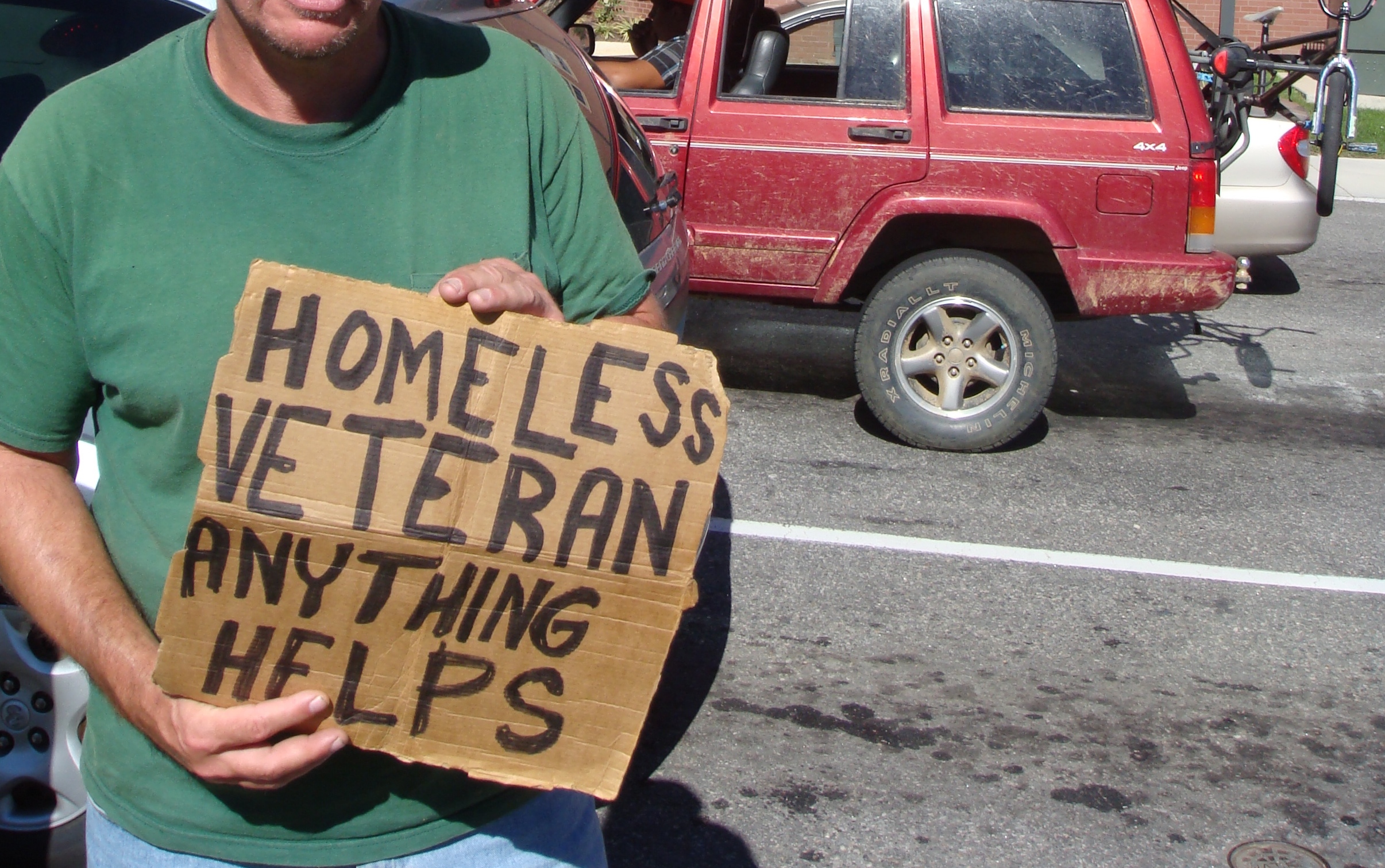
“Nurse Jo!” he yelled as he hopped up on the sidewalk beside me, grinning. On the street corner near us was a middle-aged white man holding a cardboard sign, with large hand-written words: “Homeless Veteran. Anything Helps.” I hadn’t noticed him before. He turned toward us. I saw it was James,* another former Street Center clinic patient of mine. He and Bruce were longtime friends, both were Viet Nam vets, and both were River Rats.
I talked with them for a while, imagining this was all part of a bad Southern Gothic version of a Woody Allen movie script. Bruce told me he had tried to drink himself to death but it hadn’t worked. The VA doctors were good and they were taking better care of him than they used to. He had a room in a house in Oregon Hill and had managed to stay there most of the time over the past ten years. He never got the trailer home he’d wished for. He’d cut back on his drinking and his blood pressure was better. The two men gleefully compared blood pressure readings, trying to impress me. Nurses are supposed to like that sort of thing. James had been living in Florida for a while and had just hitchhiked back to Richmond the day before. He was camping down by the river with buddies, with other modern-day River Rats.
“Mad Dog died last month, man. Did you hear Mad Dog died?” Bruce asked James. I didn’t know Mad Dog. While they were making plans to hook up later, I looked past them to the south. I could see cars speeding past us on the Downtown Expressway. Under the Belvidere Street Bridge that crosses the Expressway, I saw a group of four white young adults sleeping on old mattresses. At the top of the hillside above them there was a large hole in the fence, and beyond that was a boarded up house on the edge of what remained of Oregon Hill. The Hollywood Cemetery and Confederate shrines remain. Nothing had changed and everything had changed.
___________________
Take a look at the great (short) documentary video about a Seattle-based play Don Quixote and Sancho Panza: Homeless in Seattle, written by Rose Cano, a Spanish medical interpreter at Harborview Medical Center Emergency Department. The play is in response to a question she asked herself, “How do people maintain their dignity while being homeless?” As she explains in this video, one of her answers is: through the friendships and ‘street family’ relationships that develop for many people—including for people like Bruce.
* Names and other identifying details of former patients have been changed.
Cross-Over Clinic/The Richmond Street Center May 1986/Josephine Ensign
Health and Homelessness in Richmond, Virginia in the 1980s: The clinic I worked for at the Richmond Street Center—Cross-Over Clinic*—was started by physician Cullen Rivers and his Presbyterian church friend, the Reverend Judson “Buddy” Childress. Buddy had been a life insurance salesman before going to seminary. His ministry was to business and professional people, as he said: “linking the talents and resources of suburban Richmond to the needs of the inner city poor.” For two years before the Street Center clinic opened, Cullen and Buddy had run a Saturday health clinic out of a downtown Richmond storefront apostolic church.
Balding, with long sideburns as bookends around a serious, intelligent-looking face, Cullen was prone to wearing cardigans. He was practical and caring in a genuine way, one of those people with a quiet personal faith you wouldn’t mind having yourself, even if you were agnostic. Some people have a loud, yelling at you through a megaphone, obnoxious sort of faith. He wasn’t like that, and it was one of the things that attracted me to Cross-Over Clinic. That, and the fact that he and Buddy were trying to provide free basic health care for poor people. Cullen was my main medical back-up, available to me by phone for questions; he exuded an unflappable, competent demeanor, as well as respect for me as a nurse. Buddy convinced the local Sisters of Bon Secours to pay my salary. I was the first employee of Cross-Over Clinic and began my work at the Street Center in May 1986 (photo is of me on the first day of clinic).
Over the nearly four years that I worked at Cross-Over Clinic, I grew as a health care provider and as a person. I was the sole health care provider M-F at the clinic for the first three years, before a Health Care for the Homeless grant (with the Daily Planet as lead agency) allowed Cross-Over Clinic to hire Dan Januzzi as a full-time physician. Cullen and other volunteer physicians and dentists came in on Saturdays to provide care for the more complicated patients.
Nurse-run clinics were rather frowned upon in Virginia (and still are), and less than six months into beginning my work, the Virginia Health Regulatory Board opened an investigation of my ‘too independent’ practice. I’ve written about this experience in a previous blog post, “Not Just Culture” (11-19-11). And, as I’ve written before [see my recent “No Place Like Home(less)” in Pulse: Voices from the Heart of Medicine], even though I was never charged with anything, the stress of the 18-month long investigation into my practice contributed to the loss of my faith, job, family, and home: I spiraled into homelessness.
It didn’t help that when Buddy became the clinic director during my final months there, he admonished me not to refer women for abortions and to council patients with HIV to repent of their sins. When I refused, he put me on a mandatory leave-of-absence to be spent in ‘prayer and reflection to ask for a humble and teachable spirit.’ He also admonished me to return to church and to my husband from whom I was separated. The Cross-Over Clinic lost the Health Care for the Homeless grant funding due to issues of–shall we say–lack of appropriate separation of church and state. The Cross-Over Board also decided to focus its mission on the ‘working poor’ rather than on the homeless population. I did not part from Cross-Over Clinic on the best of terms.
Several years ago I decided to revisit Cross-Over Clinic to see what they’re up to and perhaps to try and heal old wounds. I was scheduled for an interview and site visit with Dan Januzzi, still the Medical Director of the clinic. Dan and I hadn’t parted well, but he was friendly and welcoming on the phone when I talked with him to schedule a visit. He is committed to what he calls poverty medicine, charity care medical practice focused on indigent patients.
I drove down Belvidere Street, past the corner where the Street Center had been, and across the James River. In amongst rundown Pentecostal churches, greasy car repair shops, and towing companies, sits Cross-Over Clinic. The building looks like it might have been a used-car dealership. Printed signs greet you when you enter: “We are sorry if you have to wait to see us. Thank you for your patience,” and, “Cross Over does not receive direct government funding. Our services are possible through funding by the community.”
The waiting room was small and cramped, with fifteen or so patients already seated. I checked in at the front desk and was told to have a seat. At first I was irritated, then amused, sitting there in the waiting room of a clinic where I had once worked–in a clinic that had changed my life so profoundly. A woman seated next to me started cussing loudly at no one in particular about the long wait times. After an hour of waiting I decided I had experienced enough; I left and have not returned.
From public records, I discovered that Cross-Over Clinic has an annual budget of $2.5 million, and receives an additional $2 million of in-kind donations: doctors, nurses, dentists and pharmacists volunteer for Saturday clinics—they call these “mission trips that you don’t have to leave the country for.” A local private hospital does $800,000 of clinic lab work per year free of charge and the hospital uses it as a tax write-off. VCU/MCV Medical Center (one of my alma maters) sends nursing, pharmacy, and medical students to assist with clinic. Cross-Over sees about the same number of patients per year as the Daily Planet clinic, although they include outreach screenings in churches by lay volunteers in their patient numbers.
Virginia has the second highest number of free clinics in the country. North Carolina has the most, and Georgia is close to Virginia’s number. Most free clinics, like Cross-Over, are faith-based, and since George W. Bush’s Faith-Based Initiative, are legally able to discriminate in provision of services and in hiring (and firing) practices. George W. extended his father’s campaign to blur the separation of church and state.
I find it ironic that the principle of the separation of church and state had its founding in the U.S. in 1786 less than a mile from the Richmond Street Center, at the Virginia General Assembly, when they voted in favor of Thomas Jefferson’s Virginia Statute for Religious Freedom. This statute was the forerunner of our country’s first amendment protections in religious freedom. Part of Jefferson’s statute stipulated that no person could be compelled to attend any church or to support it with taxation.
President Obama promised to reverse the erosion of basic civil rights (and the erosion of separation of church and state) from the Faith-Based Initiative, but so far, he has not done so. U.S. Congressman Bobby Scott from the 3rd District in Virginia, which includes Richmond, is trying to address this issue. He is the first African-American congressman from Virginia since Reconstruction, and he has an excellent ‘Faith-Based Initiative’ information page along with an explanation of how it allows discrimination based on race, gender (and, I would add–sexual orientation), as well as on religion.
While I don’t agree with how I was treated as an employee of Cross-Over Clinic, and neither do I agree with their principles of ‘poverty medicine,’ I know that many Richmonders view Cross-Over clinic as an essential part of their health care safety net. Which is probably true given the fact that Virginia has an extremely ‘hol(e)y’ health care safety net [see previous post: “Got Medicaid (Expansion) Virginia?” from 6-20-14).
* The clinic was called/spelled ‘Cross-Over Clinic’ when I worked for them. Since then, they have variously called themselves ‘Cross Over Clinic’ and ‘CrossOver Clinic.’
Health and Homelessness in Richmond, Virginia in the 1980s: Although I was intimidated by her when I first started working at the Richmond Street Center in 1986, I quickly came to view Sheila Crowley as a valuable mentor.
Sheila Crowley was the Executive Director of the Daily Planet (the lead agency of the Richmond Street Center) from 1984-1992. She left the Daily Planet in 1992 to work on her doctorate in social work, focusing on housing policy. As part of her doctorate, she did a yearlong housing policy fellowship on Capitol Hill. Since 1998 she has been President and CEO of the National Low Income Housing Coalition (NLIHC), based in Washington, DC. The NLIHC works on socially just national housing policy issues, public education, and research. They publish the annual Housing Wage/ Out of Reach Report, which shows side-by-side comparison of wages and rents for all U.S. counties, metropolitan areas, and states.
In my telephone conversation with Sheila several years ago, she characterized the national policy climate as “a disconnect between the response to homelessness and the response to the housing shortage.” She commented on how homelessness has become institutionalized and taken for granted, with so many more people working within the homelessness industry than when it originated in the 1980s, and with even more displacement of low income people from housing.
I had been thinking about similar things. After more than a quarter of a century working with homeless people in the U.S., it disturbs me that there are more, not less people experiencing homelessness, illness, and lack of access to basic health care. There are more specialized services for homeless people in our country than there were three decades ago: homelessness as a problem has become institutionalized. Within the federal government, the Interagency Council on Homelessness includes representatives from fifteen different federal agencies related to homelessness. Homelessness has become an industry. There are currently at least 1 million people working directly with homeless-focused agencies. Homelessness is an assumed aspect of modern American urban life, often portrayed in Hollywood movies as part of a gritty, authentic urban backdrop. I had been asking myself whether by working in the ‘homelessness industry’ I was doing more harm than good: harm in that I helped make homelessness more palatable to people experiencing homelessness, as well as to our housed community members (and yes, even to myself: a literal “I gave at the office” sort of a thing). I haven’t found an answer to my question, but I continue to think it’s an important one to ask.
Sheila gave me broad-brush characterizations of the Clinton, Bush, and Obama administrations’ approaches to housing and homelessness. Under Clinton there was emphasis placed on de-concentration of low-income housing, with the unintended consequence of a net loss of low-income housing units. The Bush administration placed emphasis on increasing home ownership rates, with some funding going to McKinney Homeless Assistance for housing programs. Obama appointed a great Housing and Urban Development (HUD) director, Shaun Donovan, and Sheila had high hopes, but at the time of our interview she felt that not much had been done. The Homelessness Prevention and Rapid Re-housing Program funded through the American Recovery and Reinvestment Act of 2009 appears to have been effective at preventing the worst of recession-related increase in homelessness, although the numbers of unsheltered and doubled-up homeless increased during the 2009-2011 time period.
Sheila and I talked about how even the term ‘homeless’ is problematic on many levels. In the U.S. there have been different official federal definitions for homeless. Until recently the Department of Housing and Urban Development only included the visible or literal homeless—those living on the streets or in emergency shelters. Other federal definitions, such as those necessary for receiving health benefits, have had broader definitions that included people temporarily doubled-up with friends or family, people living episodically in cheap hotels, and people living in cars or other places not intended for human habitation. This definition encompasses people in many different variations of being marginally or precariously housed—as I had been as a young adult. The HUD definition was amended in December 2011 to be more in line with this broader definition of homeless.
Sheila described being at a Homeless Advocates Group (HAG) national meeting recently. HAG is composed of leaders of all the major groups working on homelessness at the national level, including the NLIHC, the National Health Care for the Homeless Council, and the National Alliance to End Homelessness. She looked around the meeting room and realized that all of the leaders of the represented agencies and coalitions were now in their fifties and sixties and had gotten their start in homelessness work in the 1980s. She thought to herself, “Here we go again,” with the increase in the number of homeless, this time due to the national foreclosure crisis and effects of the prolonged recession.
She was quick to highlight success stories, communities that are pulling together coordinated responses to homelessness with a Housing First emphasis—working to maintain people in adequate affordable housing and to quickly re-house people—and a Housing Plus approach of providing supportive housing for people with mental or physical health or substance abuse issues complicating their homelessness. People cannot be healthy unless they have safe and healthy housing. She mentioned Columbus, Ohio and Worcester, Massachusetts as two examples of successful community responses, and added that my new hometown of Seattle has done pretty well with a significant decrease in the chronically homeless population. Across the country, there’s been resistance from emergency shelter providers and church-sponsored programs who see funding and support moving away from their services. But the Housing First movement has had broad bipartisan support since it cuts across different political ideologies.
When I mentioned to Sheila what now stands at the corner of Belvidere and Canal Streets where the Richmond Street Center had been (it is now a VCU college dorm building and a Starbucks), she immediately said, “The only thing I regret about the Street Center building being torn down was the elevator.” This surprised me until I remembered what a practical woman Sheila is—a common character trait of many of the social workers, as well as of public health nurses I have known. She reminded me that the city inspectors had insisted she fund and install a $30,000 elevator in the Street Center building before it could open. She hopes they were at least able to re-use the elevator for another building. She also recounted the construction of the addition on the back of the Street Center for the expanded clinic space I worked in. A sinkhole opened up in the parking lot while they were preparing the foundation. That’s when they discovered that the Street Center was built on land that had been the city dump. Sheila said she went back to where the workmen were standing around looking at the hole, rubbing their chins, exclaiming, “It’s the darndest thing,” and she responded, “Well don’t just stand there, do something about it!”
We need more people like Sheila who don’t just stand around contemplating problems, but who roll up their sleeves and try to solve them.
The State of Homelessness in America 2014 report from the National Alliance to End Homelessness. The overall rate of homelessness in the U.S. decreased by 3.7% for the time period 2012-2013, although it increased in 20 states.
The James River and Richmond Skyline 2014/Josephine Ensign
Health and Homelessness in Richmond, Virginia in the 1980s: A half-mile south of the Richmond Street Center was the wide James River. Along the riverbanks lived a group of my patients who called themselves the River Rats.
The River Rats consisted of a dozen or so adults, mostly men, with a few women who were married or otherwise attached to the men. The River Rats ranged in age from twenty-six years old, to an older man named Bruce* who said he was fifty-two, but looked much older. Many of the River Rats lived together under a bridge by the river. They were heavy drinkers who enjoyed the relative freedom of living outside on their own. The frat party atmosphere permeated the area. On summer weekends the River Rats drank alongside the young Richmonders who sunbathed on the flat rocks, or inner tubed in the smaller rapids, floating coolers full of beer beside them.
A few of the River Rats rode the rails. They hopped on and off the freight trains passing through Richmond. They were traditional hobos out of a different era. They had been to more parts of the country than most people had in their lifetimes—certainly more than I had been to at the time (I was in my mid-twenties then). Several of them came to me with hand and knee abrasions from tumbling off a moving train and getting scraped up on the gravel railroad track bed. In my second year at the Street Center, one of my regular rail-riding patients was buried alive in an open coal car the morning after he’d celebrated his thirtieth birthday by getting more drunk than usual. His travel partner told me about it the next time he came into the clinic.
Richmond was (and still is) at the cross-roads of two major east coast interstates, I-95 and I-64, as well as of two major freight train lines, so the city got a fair number of people traveling through, hitchhiking or riding the rails or the Greyhound bus, who stopped and got stuck, or stayed for whatever reason. They were like the flotsam caught in swirling eddies of the river.
There was discussion in the two local newspapers about whether the homeless people in Richmond were really from Richmond, or even from Virginia. Many of the newspaper articles featured interviews with homeless people who said they were from Baltimore, or New York City, or Philadelphia. The underlying implication was that many of the homeless people in Richmond were from the North; therefore, they were either invaders, or proof that the large northern cities were dumping their problems on Richmond, taking advantage of Southern hospitality. Richmond was enabling felons, drug addicts, and lazy people who were homeless by choice. They would never be able to be recycled into productive citizens, the articles seemed to say. Newspaper articles were more sympathetic to homeless people in Richmond who reported being from impoverished rural areas of Virginia or North Carolina. Whether they were black or white, they had been dealt a bad hand in life. They were our people and we took care of them.
Homelessness was an urban problem I associated with large, gritty urban areas like New York or Baltimore. I was surprised to see homelessness on such a large scale in my own hometown. The center of Richmond was decaying. Discarded carcasses of old buildings were everywhere. There were buildings with boarded up windows and doors, charred remains of other buildings, people’s belongings dumped in disheveled piles on the sidewalk curbside: evidence of evicted people, now homeless. Driving through the city at night you could catch glimpses of dark darting shadows or muffled flashes of a cigarette lighter, flashlight, or candle in some of the boarded up houses. The shadows were squatters, homeless people—ghosts. Houses that were still legally lived in showed signs of faded beauty. Stone cornices and intricate wooden lattice dangled loosely from front porches.
Along Belvidere Street near the Street Center, two blocks of houses had been razed to make way for expansion of the university. For over a year, to cordon off the construction site from sidewalk and street, the construction crew lined up old doors from the torn down houses. They leaned the doors against temporary chain-link fences anchored by large concrete blocks; this made a long expanse of multicolored doors, which was as beautiful and shocking as a modern art installation. Sitting in my car at a stoplight on my way to and from work, I’d stare at the doors. I marveled at the deeply saturated red doors, wondering what sorts of rooms they had opened into. There were also a few doors that had obviously belonged to children’s bedrooms. They were decorated with brightly colored Disney characters like Donald Duck and Cinderella. I wondered if some of the doors had belonged to patients of mine who were now homeless. And I wondered what it must feel like to be a child and recognize the stickers from your old bedroom door as you were being dragged along the street by the hand toward the emergency shelter.
In stark contrast to the dismantled and rotting parts of the inner city were patches of rebuilding and renovating. The biggest of these was the ill-fated $16 million glass-enclosed Sixth Street Marketplace spanning Broad Street. Built in 1986, the Marketplace was meant to bring back small businesses to the downtown core of Richmond. It failed and was torn down less than twenty years later at a cost of $67 million. Closer to the Street Center was the grand Jefferson Hotel, built with tobacco money after the Civil War. It had been sitting empty for over a decade, although it was occasionally used to film movies or host high school proms. The grand staircase of polished marble was rumored to have been the model for the staircase in Gone With the Wind. My Lee-Davis High School senior prom had been held there as the hotel was closing.
By 1986 they had completed a $34 million dollar renovation of the Jefferson, and the hotel was reopened simultaneously with the opening of the Street Center. The buildings were several blocks apart. Standing in front of the Street Center on Canal Street, the Jefferson loomed over the top of it: pale grey marble against dark brick, majestic rich above outcast poor. At night the tall grey clock tower of the hotel glowed in the floodlights.
* Note: All names and other identifying details of former patients have been changed.
What poetry does: inspires, transforms, moves, agitates, articulates, imagines, disturbs, delights, and mystifies.
What poetry does (according to Emily Dickinson): “If I read a book (and) it makes my whole body so cold no fire can ever warm me I know that is poetry. If I feel physically as if the top of my head were taken off, I know that is poetry.”
Poetry happens. All around us. Every day. Even if we aren’t fully aware of the fact, the muses are whispering subliminal sweet everythings in our ears.
Poetry needlessly intimidates; poetry is relegated to the shelf labeled ‘inaccessible.’ At least that is the case for most adults; children seem to be born poets and we educate them out of it. Goodnight Moon, along with most other popular children’s books, are really illustrated poems.
Along with Cicero so long ago, pragmatic people proclaim that poetry and art are dead. Not true.
I love poetry and have been a mostly closeted writer of poetry. My first (and so far, my only) published poem at age nine (in my elementary school newspaper) was a haiku: “A hurt cricket limps/helplessly and hopelessly/into the forest.” At the time, I wanted to be an entomologist, or a veterinarian, or a writer. I most definitely did not want to be a nurse, but when I re-read this haiku, I see the empathy and compassion that later led me to nursing. Several years ago when my mother was dying of cancer and in home hospice, I found that I could only read poetry. Poetry has a magical quality.
I use poetry in my teaching. For nursing students, I’ve found that it helps to use a healthy dose of poems written by nurses. They resonate more closely for the students, and also make poetry less frightening to students who equate poetry with totally inaccessible, frustrating writing. For instance, I often use the powerful poem by Cortney Davis, “I Want to Work in a Hospital” “where it’s okay/to climb in bed with patients/and hold them—” to spark a discussion on empathy and the murky realms of professional boundaries and burnout. I love the moment in class when I read that opening line, hear a dampening of background noise, and look out over the sea of faces suddenly fully attentive. Poetry is magic.
I use poetry writing in my teaching, but I often sneak this in by not announcing it as poetry writing. For many years, in my health policy undergraduate course, I had students write an American Sentence of their take-home message for that class session. (See my previous blog post “Nurses and Writing the American–Healthcare–Sentence.”) An American Sentence is an ‘Americanized’ version of haiku and is a sentence consisting of 17 syllables. With a class of 150 students, this assignment did double or triple duty: it reinforced their in-class learning of concepts; it forced them to focus and hone their writing skills, and it helped me to read all of their writing before the next class session. Here are a few of my favorite student American Sentences about health policy: “US healthcare: purposeful opacity in service to the rich.” and “Sticks and stones will break our bones, but prevention is the way to stop it #nopoetryskills.” OK, so obviously the student who wrote that last one had figured out the poetry part. Good use of humor and Twitter.
In the final class session of the narrative medicine course I taught this summer, I had the students write either a haiku or an American Sentence to sum up their overall take-home message from the course. Here are some they came up with in 10 minutes of writing time: “Words, poems, artwork/Express the unspoken pain/We need to release.” “Prompted to write, to my surprise, the narrative created healing.” “So close yet so far/More questions raised than answered/ Curiosity.” “Healing is an art/in this class/that is what I get.” (This last one is technically a Lune/American Haiku, but I like it.)
I continue to search for ways to sneak more poetry into not only my teaching, but also into my writing life and into my life. The photograph here is from the Te Papa Museum, New Zealand’s amazingly wonderful national museum in Wellington. They had a ‘make a poem’ board with those little magnetized words in both Maroi and English that adults and children could play with and change around into ephemeral poetry: word art (or toi kupu, which I think literally translates to ‘speak art’–lovely!). When I was there this past February I stopped and wrote a poem mixing English and Maori words, using the Maori words by instinct since I don’t know more than a few words of Maori. Here’s what I came up with (translated into English, and I suppose this counts as my second published poem. Move over hurt cricket!) Poetry happens; let it happen to you.
The U.S.-based ALS (Lou Gehrig’s Disease) Association has struck gold with it’s social media fundraising campaign, the ice bucket challenge. Even my neighbor across Lake Washington, the gazillionaire and global health guru Bill Gates has doused himself with ice water and presumably has donated money towards ALS research. As of today, the ALS Foundation has raised 88.5 million dollars, and according to news reports, they are trying to figure out what to do with all the money.
ALS is a terrible disease with a terrible burden on not only the ALS patient, but also on his or her family due to the years of increasing and intensive home care usually associated with the disease. I had a childhood friend who developed ALS, and my elderly father spent many hours doing direct care so that the patient’s wife could get some rest. I suppose ALS has been lumped in with ‘orphan diseases,’ diseases and disorders that are relatively rare, unknown, unsexy, and unprofitable for the large multinational drug industry. So it is a good thing the ALS Foundation now has more funding for research. By contrast, cancer and Alzheimer’s Disease are both big, scary, well-known diseases that get most of our research funding. That’s because they are both highly profitable diseases for drug companies and for the health care system.
But why not do an ice bucket challenge to raise money and awareness for devastating diseases like Ebola?
An ice bucket challenge to raise funds for Ebola research, education, and health care, would likely fail because Ebola, like the disease burden from most other infectious diseases, is largely isolated to the poorest and most remote villages of Africa. “It’s over there where the poor, illiterate, ignorant Africans live, so who cares?” (I’m quoting an imaginary Archie Bunker, but it is a very real and highly prevalent belief in our country). It seems that there have only been two confirmed cases of Ebola in the U.S. so far. They were both white American, Christian missionaries working in Africa who were flown back to the U.S. on private jets and given state-of-the-art (expensive) inpatient health care–including experimental medications– at the CDC-associated hospital in Atlanta. Of course, they both recovered and have now returned to their homes.
Meanwhile, nurses and doctors and burial workers in Liberia, Sierra Leone, Guinea, and Nigeria struggle to take care of an increasing number of Ebola patients. The NYT this week published an article and accompanying video highlighting the work of amazing nurses in Sierra Leone–nurses like Josephine Finda Sellu–who are taking care of Ebola patients because: “You have no options. You have to go and save others (…) You are seeing your colleagues dying, and you still go and work.” (“Those who serve Ebola victims soldier on” by Adam Nossiter and Ben Solomon, 8-23-14).
For some important (and largely overlooked) perspective, consider the findings of this recent study on the global health disparity in disease burden and in disease research. In their April 2014 PLOS (open-access, peer-reviewed scientific journal) article “Attention to Local Health Burden and the Global Disparity of Health Research,” researchers Evan, Shim, and Loanidis found that “the production of health research in the world correlates with the market for treatment and not the burden of disease.” Measuring disability-adjusted life years (DALYS–a now standard health measure for the number of years lost due to ill health, disability, or premature death), they report a global disease burden from infectious/parasitic diseases (such as HIV, TB, diarrheal diseases, malaria–and Ebloa) of 269 million years worth of DALYs. This is in stark contrast to the global disease burden of all malignant neoplasms (cancers) of 69 million years of DALYs. Then they show that the overwhelming majority of the world’s medical research dollars goes to cancer and to neurological diseases (mainly Alzheimer’s Disease, but ALS also falls into this category). They conclude that “the inequality of research limits current quality of care in less developed countries.”
Please remember that and also the heroic work of nurses like Josephine Finda Sellu, whenever you hear anyone mutter any sentiment close to “It’s over there where the poor, illiterate, ignorant Africans live, so who cares?”
I propose an ice bucket challenge for Ebola. Instead of wasting clean water and ice (luxury items, of course, in villages like those in Sierra Leone), consider donating money to support the work of organizations like Doctors Without Borders or Partners in Health. Practice what physician Paul Farmer calls pragmatic solidarity. Pass it on…
I’m into the power and nuance of stories and storytelling and lately have been focused on digital storytelling (DST). I have some of this content in my Soul Stories project section on this website, but I also wanted to expand upon it here.
DST refers to short video segments (typically 3-5 minutes in length) personal narratives that incorporate digital images, music, and voice-over narration by the person making the video. They are typically created within a workshop-based process that includes a Story Circle to share, critique, and refine stories-in-progress. Developed in the early 1990s by media/theater artists Dana Atchley and Joe Lambert and promoted through their Center for Digital Storytelling (CDS), DST has been used for public health research, training, and policy campaigns (such as the Silence Speaks campaign); community building (such as the BBC Capture Wales program); literacy programs; and reflective practice with health science students. DST is increasingly used as an innovative community-based participatory method that is especially effective at informing program planners and policy makers about the lived experiences of marginalized people.
Here is an example of a DST video “My Story of Community Health Nursing” that I made recently using the user-friendly storyboard style video editing software program WeVideo. My aims in doing this short video were: 1) to try out the WeVideo software (they have a free version, but they include an advertisement at the end of those videos), and 2) to tell the story of where community health nursing has taken me over the past thirty years. I purposefully kept it fairly low-tech and no-frills, didn’t try to add layered music or sound effects or fade ins, and I made this DST video without the use of a group Story Circle setting. I made it using my MacBook Air and its built-in microphone. It took me about two full days to produce the video, but that included the storyboard work as well as learning to use the WeVideo editing tools (which are really quite easy and they include helpful instructional videos). This would be a great resource in teaching (they have an educational platform that includes the requisite student privacy/protections).
I plan to do a second version of this soon within an ‘official’ DST Story Circle setting with more professional sound equipment to try out that experience. One of the critiques of the ‘official’ DST workshop model is that the workshop facilitators typically impose the use of a traditional, linear, redemptive storytelling narrative; this can exclude people and stories which do not fit this model. Researchers and DST practitioners such as Worchester call for use of a more flexible, co-created space for DST, including how narrative parameters are established in the workshop (Worchester, Lara. “Reframing Digital Storytelling as Co-Creative.” IDS Bulletin 43.5 (2012): n. pag.).

 My father died this morning. He died peacefully in his bed at home surrounded by family members, trusted caregivers, and my late mother’s artwork. This photo, which I took a few weeks ago, shows my father ‘getting his daily exercise’ doing laps inside his house using his walker, under the watchful eye of my mother (the painting is her self-portrait about her own heart disease). My father died from the effects of congestive heart failure. When he died, my father wasn’t exactly wearing his boots and gardening gloves, but very close to it. Our family harvested sweet potatoes yesterday from my father’s backyard garden.