Cover Girl lipstick ad/The Ladies Home Journal June 1964
Greeting me at my favorite local independent bookstore this past week was this interesting ‘Health’ section display:Being skinny (or at least dressing skinny), wearing dark red lipstick and super expensive perfume equals health for women? I realize the display is meant to cash in on popular New Year’s resolutions within our culture, but I still find it provocative on many different levels. I was sorely tempted to add ‘hazards’ under ‘health’ but didn’t want to get evicted from the bookstore.
By now the health dangers of the skinny woman syndrome are well known. Eating disorders such as anorexia, bulimia, yo-yo/extreme/bizarre dieting. Expensive, dubiously medically-regulated, and sometimes fatal cosmetic surgeries. Beautiful Beyonce’s song “Pretty Hurts” does a good job of summing up this topic.
Something seemingly simple and innocuous as lipstick… How many people know that lipstick is a public/environmental health issue? Many popular brands of lipstick contain lead and at least eight other metals known to be harmful to humans. The FDA does not have any regulatory authority over the cosmetics industry, leaving the the 58 billion dollar a year industry (in the U.S./estimate for 2014) to self-regulate. Deborah Blum wrote a NYT Well blog article on this: Is There Danger Lurking in Your Lipstick? (8-16-13). The Campaign for Safe Cosmetics has good, up-to-date information on this issue. And the health story on perfume is perhaps even more depressing, so I will skip it and let you read all about the petroleum products, allergens, neurotoxins, and synthetic musks here.
For some historical perspective (and some sad-funny stuff), I stumbled across my mother’s copy of The Ladies Home Journal, the June 1964 Special Issue. It features an article by Betty Friedan ‘Woman: The Fourth Dimension.’ Written a year after she published the now classic second-wave feminist book The Feminine Mystique, her ‘fourth dimension’ of a woman’s existence is “woman as a person herself, employing all her intelligence and abilities in a changing world.”
The numerous ads for beauty products in this special Fourth Dimension edition are quite telling. Besides the one for lipstick I’ve included at the beginning of this post, here are a few that stand out as both Mad Men retro and disturbingly not-so-retro (and yes, there were only white people in this magazine):
Skin cancer anyone?
Here is a full-page fashion shot of a ‘four-dimensional woman’ as a beautifully coiffed and attired artist (my mother, who was a professional artist with an MFA dog-eared this page–hopefully only out of amusement):
But this photo and caption included in Friedan’s article puts a new spin on better living through chemistry and on the value of an education (the caption says “Velta Sparnins, mother of three children, attends college on a scholarship”):
As I finish grading student papers for an undergraduate community health course, I am reminded of the two most influential courses in all of my undergraduate and graduate education: 1) Comparative World Religions taught by Clyde Holbrook, Oberlin College in 1980; and, 2) Water and Sanitation taught by Clive Shiff at Johns Hopkins School of Public Health in 1992 (in which we applied a problem-based learning/case study approach to a Zimbabwe village water and sanitation project in a team-based approach with health care providers from mostly resource-poor countries). These two courses on seemingly disparate topics were the most personally transformative for me in terms of expanding my worldview and enhancing my critical thinking skills. Those, in turn, are two of the most important educational outcomes or standards that I aim to teach to in my work educating future nurses and other health care professionals.
As a society, as a world, what do we most want and need in health care providers? Yes, of course, we want and need intelligent, highly competent providers who are up-to-date on all of the latest scientific, evidence-based practice guidelines. But robots can do that. What we really want and need are flesh-and-blood, compassionate, grounded, and questioning humans who understand at a visceral level what it means to face existential questions of life and death; what it means to face complex personal and community-level ethical issues; and what it means to wrestle with the visceral, practical questions such as how to best to take care of basic bodily functions (like pooping and peeing) and how a community can obtain safe, clean drinking water (and the complex political, cultural, social, and historical issues related to that access).
In order to have more health care providers capable of such things, in order to ‘humanize health care,’ we need to have better support of the humanities within basic primary education, undergraduate education, graduate education, and continuing education…. Ah yes, and we need to have more health care (especially nursing) educators who have meaningful exposure to, education in, and orientation towards the humanities. By humanities I mean “the study of how people process and document the human experience” (source: Stanford Humanities), which typically includes the academic disciplines of: philosophy, literature, religion, art, music, history, and language/linguistics. Humanities and a ‘liberal arts’ education are foundational to our country and to democracy; they are also currently being undermined by a focus on ‘practical’ jobs-based education in STEM (non-humanities) subjects: Science, Technology, Engineering, and Math. As an important counterpoint to that trend, I encourage you to view the brief (7 minute) video “The Heart of the Matter” by the American Academy of Arts and Sciences (to accompany their 2013 report of the same name).
Remember to ask the important questions: who are we? where did we come from? why are we here? where are we possibly going? and where is a safe place to poop?
We’re used to hearing the term ‘first responders’ whenever there’s any news coverage or conversations about disaster/emergency preparedness, response, and recovery efforts. And we’re used to seeing images (like the one below) of the typical types of official first responder personnel and their equipment: firefighters, police officers, EMS, Search and Rescue, etc.
This past year I’ve become more aware of the importance of cultural and spiritual first responders, especially in terms of the resilience of communities. Spiritual first responders we may think of as only pastors, priests, imams, and other religious leaders. These people are important sources of solace and ethical guidance. But the cultural and spiritual first responders I’m referring to are the artists and writers within communities who aid in our attempt to make meaning out of catastrophe and chaos, to find ways to not only survive but also thrive in the midst of adversity. They point the way to healing, to the alchemy of remembrance and forgiveness, to resilience.
I’m currently writing an essay ‘Bearing Witness’ about these cultural and spiritual first responders, and about the sticky ethics of witnessing. In the spirit of Thanksgiving, I want to share with you some photos I’ve taken (within the past year) of powerful public artwork in response to the Christchurch earthquakes and ongoing recovery. I am very thankful for the inspiration, perspective and meaning-making they have provided for me. I include the artist’s name when I’ve been able to establish who they are. These are in addition to ones I shared in a previous blog post “Bounce Back” (February 7, 2014) when I was living and working in New Zealand.
I believe this street art mural on the side of a partially-demolished building in downtown Christchurch was part of Canterbury Museum’s ‘Big Walls’ street art project. I haven’t been able to discover who the artist is but I love this arresting piece. Is the hand held up to stop you from coming too close into the danger zone? Is it calling on you to halt your strange disaster walkabout and reflect on what you are seeing, on what you are doing here?
Peter Majendie’s ‘temporary’ installation “185 Chair Memorial” set up in an empty lot in downtown Christchurch, on land where there had been a Baptist Church before the earthquakes destroyed it. (The A-frame white building in the background of this photo is the gorgeous “Cardboard Cathedral” by Japanese architect Shigeru Ban.) Majendie’s original title for his chair installation was “Reflection of Loss of Lives, Livelihood and Living in Neighborhood” and was initially set up in February 2012 for a week to mark the first anniversary of the most devastating Christchurch earthquake. Each of the 185 white-painted chairs represents a person killed by the earthquake. There are desk chairs, bar stools, lawn chairs, stuffed lounge chairs, folding chairs, rocking chairs, children’s chairs, director’s canvas chairs, infant car seats, infant highchairs, and wheelchairs. The sign encourages people to sit quietly in a chair to which they are drawn. “The installation is temporary—as is life,” the artist states.
Love this one! “Weaveorama” is an interactive street art installation by textile artist Hannah Hutchinson. Part of the Gap Filler project in Christchurch, it is a giant public loom with a sign that says “join with us in creating a new city fabric” and encouraging people to add their found or recycled objects. I especially loved the addition of the pink satin bra. Finding a place for appropriate humor and whimsy is important for individual and community resilience.
Here are a few of my current favorite narrative medicine/medical humanities things:
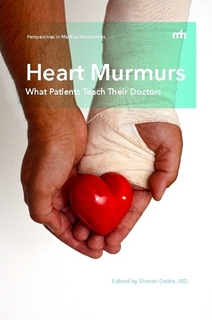
Heart Murmurs: What Patients Teach Their Doctors(UC Medical Humanities Press, 2014). This new collection of personal narratives by physicians, edited by my colleague Sharon Dobie, MD, a family medicine doctor who teaches and practices relationship centered care. In these essays Dr. Dobie and thirty-five other physicians explore lessons they’ve learned from patients.
Those whacky and wonderful Brits have a much better health care system than we do, and they have this wonderful new (creative) collection (is it a book? is it a collage?) on medical humanities. Published by the Wellcome Collection, Where Does It Hurt? The New World of the Medical Humanities is both entertaining and thought-provoking. (While you’re at it, spend some time browsing their website for fun quizzes, interactive educational games, videos, and more). Here’s what they say abut the book:
“What does it mean to be well? Or ill? And who, apart from you, really knows which is which? Contemporary definitions of medicine and clinical practice occupy just one small corner of a vast field of beliefs, superstitions, cultures and practices across which human beings have always roamed in the search to keep themselves, and others, feeling well.The label ‘medical humanities’ is the best effort we’ve made so far to define the fence that encloses that very large field; recognising that it’s a space in which artists, poets, historians, film-makers, comedians and cartoonists – in fact every one of us – has as much right to explore as any humanities-schooled or clinically trained professional. This book is a walk through that field, a celebration of its rich diversity, a dip into some of the conversations that are going on within it, an attempt to get it in perspective – and an invitation to you to join the conversation yourself.”
The always friendly folks in the middle of cornfields in Iowa (University of Iowa) put on a terrific annual narrative medicine conference: The Examined Life Conference. They just announced that a keynote speaker for their upcoming conference (April 16-18, 2015) is poet Jimmy Santiago Baca. His memoir A Place To Stand (Grove Press, 2002) was made into a documentary released last month.
Until very recently in the United States the general feeling among most people (and among most news reports) was that the catastrophic Ebola epidemic was only a problem ‘over there in the poorest countries of Africa–all of those uneducated Africans who can’t even keep their food from getting contaminated by bat droppings.’ This summer, we were happily dousing ourselves with buckets of ice water in the (dare I say ‘silly and oh so contagious social media’ hype) of the ALS Ice Bucket Challenge. (see my previous blog post: ‘Ice Bucket Challenge for Ebola‘ 8-26-14 for additional perspective on this in light of the global health burden of disease.) At the time that I wrote that blog post we had not yet had any patients tested/confirmed with Ebola in our country. Now, of course, we have multiple confirmed cases in the U.S., including two young nurses who had cared for a patient with Ebola in a Dallas, Texas hospital.
This morning in my community health nursing class of 150 students, I asked how many of them had had any training or preparation or discussion of Ebola in their clinical rotations. Only one student raised her hand and she said that was training through her job at a hospital (presumably Harborview Medical Center in Seattle which supposedly has done a good job of Ebola education and preparedness for its employees). The majority of students said they had been asked by friends or family members for information on Ebola. I encouraged them all to read the excellent training materials for the general public and for health care providers on the CDC website–and to ask for preparedness training in their clinical sites. I also encouraged students to be attuned to subtle and not so subtle racism in news coverage and general conversations about Ebola. Even infographics about Ebola on the CDC website depict only impoverished rural African people with Ebola, in one case showing a man defecating on the ground.
The fact that it is two hospital nurses who are the first confirmed Ebola cases to be contracted in the U.S. should come as no surprise to anyone who knows and loves nurses or who has spent any time in a hospital. Nurses are the front-line, down-and-dirty direct patient care providers. These two nurses were following current (at the time–they have been updated today) Ebola infection control procedures. And whereas the latest nurse with confirmed Ebola, Amber Joy Vinson, was first reported as having breached CDC protocol and flown on a commercial plane while she had a fever, CDC officials are now confirming that she first phoned them when she had a fever and was due to fly: “I don’t think we actually said she could fly, but we didn’t tell her she couldn’t fly,” CDC director Dr. Thomas R. Freiden is quoted as saying. “She called us, (…) I really think this one is on us.” (NYT ‘New Ebola Case Confirmed, U.S. Vows Vigilance’ by Manny Fernandez and Jack Healy, 10-15-14.)
It is always ironic that it takes ‘big scary disease’ epidemics like Ebola to remind us all of: 1) how connected we are to everyone else in the world–their problems are literally our problem, 2) the importance of sustaining a robust public health infrastructure, and 3) how vital nurses are to our health care system.
Health and Homelessness in Richmond, Virginia in the 1980s: Twenty-five years after leaving Richmond, I returned to the corner of Belvidere and Canal Streets where the Richmond Street Center had been. I searched for remains of my past work with Richmond’s outcasts, for my own past as a homeless outcast.
Standing on the street corner in Richmond, I noticed that the empty lot adjacent to the Street Center, the lot that had been a curtain of kudzu vines, trees and trash when I worked there, was gone. Traffic whizzed by. Belvidere remains a four-lane street, a major north south arterial through Richmond, with heavy car, and truck traffic. As I stood on the corner, staring at the specter of what had been the Street Center, it morphed into an emerald green mermaid: a large Starbucks stands there now. For all its stamped sameness, Starbucks signals comfort and home to me, since I found refuge in its watery birthplace of Seattle. The Starbucks is on the ground floor of a fancy brick three-story VCU student college residence hall where the Street Center had been.
Looking at the Starbucks, I had a vision of Bruce,* a former patient of mine who I’d always had a soft spot for. One of the River Rats, Bruce was white-haired, shrunken, and fond of wearing overalls. I’d often see him on the sidewalks near the Street Center, pushing a metal shopping cart full of aluminum cans and a large black plastic garbage bag, with a little white dog perched on top of the pile, wagging her tail. Bruce was a boisterous alcoholic, so usually the cart didn’t go in a straight line. He liked to give away presents he kept buried inside the garbage bag: packs of Marlboro cigarettes smuggled out of the Philip Morris plant by a friend of his who worked there, and packages of Twinkies and bright pink Sno Balls from the nearby Hostess factory. With his scraggly grey beard and the bag of presents, he was like a back-alley Santa. Bruce’s dream was to get a trailer of his own where he could be left alone to drink until he died.
Bruce had been one of the nicest of my regular patients at the clinic. Even when he got drunk he wasn’t mean: if anything, he got kinder and gentler. He didn’t have a chip on his shoulder, didn’t project an “I’m angry at the world for being given such a bum rap in life” attitude. Some of the clinic regulars at the Street Center were so weighed down by anger they staggered beneath it. Bruce shuffled. He was plain sweet.
As I stood on the street corner, looking at the Starbucks store and remembering Bruce, I became aware of a figure darting between cars, crossing the street toward me. It was Bruce, minus the overalls, garbage bag full of Twinkies, grocery cart, or his little white dog. But it was Bruce, still with the same happy demeanor and not looking twenty-five years older. I had been writing about him that morning, convinced he was dead, hoping he had gotten the trailer to live in before he died.
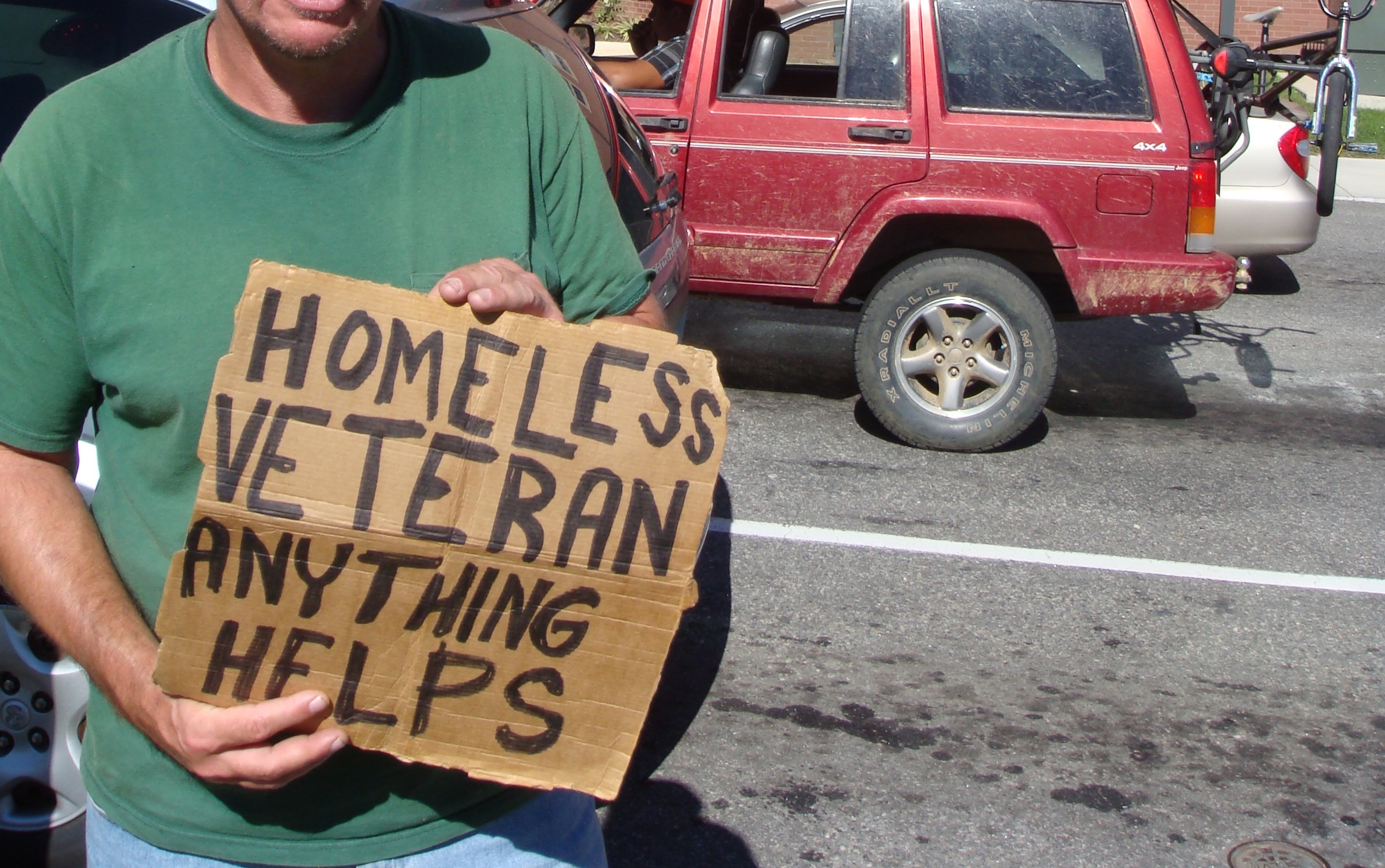
“Nurse Jo!” he yelled as he hopped up on the sidewalk beside me, grinning. On the street corner near us was a middle-aged white man holding a cardboard sign, with large hand-written words: “Homeless Veteran. Anything Helps.” I hadn’t noticed him before. He turned toward us. I saw it was James,* another former Street Center clinic patient of mine. He and Bruce were longtime friends, both were Viet Nam vets, and both were River Rats.
I talked with them for a while, imagining this was all part of a bad Southern Gothic version of a Woody Allen movie script. Bruce told me he had tried to drink himself to death but it hadn’t worked. The VA doctors were good and they were taking better care of him than they used to. He had a room in a house in Oregon Hill and had managed to stay there most of the time over the past ten years. He never got the trailer home he’d wished for. He’d cut back on his drinking and his blood pressure was better. The two men gleefully compared blood pressure readings, trying to impress me. Nurses are supposed to like that sort of thing. James had been living in Florida for a while and had just hitchhiked back to Richmond the day before. He was camping down by the river with buddies, with other modern-day River Rats.
“Mad Dog died last month, man. Did you hear Mad Dog died?” Bruce asked James. I didn’t know Mad Dog. While they were making plans to hook up later, I looked past them to the south. I could see cars speeding past us on the Downtown Expressway. Under the Belvidere Street Bridge that crosses the Expressway, I saw a group of four white young adults sleeping on old mattresses. At the top of the hillside above them there was a large hole in the fence, and beyond that was a boarded up house on the edge of what remained of Oregon Hill. The Hollywood Cemetery and Confederate shrines remain. Nothing had changed and everything had changed.
___________________
Take a look at the great (short) documentary video about a Seattle-based play Don Quixote and Sancho Panza: Homeless in Seattle, written by Rose Cano, a Spanish medical interpreter at Harborview Medical Center Emergency Department. The play is in response to a question she asked herself, “How do people maintain their dignity while being homeless?” As she explains in this video, one of her answers is: through the friendships and ‘street family’ relationships that develop for many people—including for people like Bruce.
* Names and other identifying details of former patients have been changed.
Oregon Hill in Richmond, Virginia 2012/Josephine Ensign
Health and Homelessness in Richmond, Virginia in the 1980s: When I was growing up on the outskirts of Richmond, I was taught to avoid the area of town where I would work at The Richmond Street Center . The neighborhood it was located in–Oregon Hill–was rumored to be as white, racist, in-bred, impoverished, and violent as an isolated Appalachian West Virginia hollow.
The residents of Oregon Hill were called hillbillies. Most were Scotch-Irish, descended from British bond servants who had moved to the area during Reconstruction to work at the Tredegar Ironworks and Albemarle Paper Company, both located along the James River. Darwin, in his introduction to the Origin of the Species, made reference to these settlers, called Crackers, who he said selectively bred black hogs because they were more resistant to disease than were white hogs—echoes of one of the many Southern justifications for slavery. At first Oregon Hill was a squatter’s community, with people living on the land illegally. Then the settlers built cheap houses resembling coal-mining housing units.
Oregon Hill was a Richmond neighborhood that was easy to avoid: it was physically cut off from most of the city by the four-lane Downtown Expressway toll road. Urban planners, controlled by Richmond’s white elite, catered to business interests in the downtown core. A city report from the 1930s targeted Oregon Hill for demolition, stating it contained the largest concentration of Richmond’s cases of child and adult delinquency and disease. The nearby traditionally black neighborhood of Jackson Ward (of Bill ‘Bojangles’ Robinson fame) had also been slated for demolition for similar reasons. Both neighborhoods were seen as sources of moral contamination spreading like infection or mold through the city, sapping its vitality, keeping Richmond from becoming a leader in the New South. So the city built the Downtown Expressway in the 1970s, placing it through the worst slums–or ‘urban decay’– displacing thousands of impoverished blacks and whites, moving them to low-income housing projects. The Expressway was designed to form a physical barrier protecting the affluent white West End neighborhoods, and providing their residents a safe passage to downtown jobs and industries along the river.
By the 1980s when I worked in the area, the iron and paper mill industries along the river near Oregon Hill were closed, and the only remaining neighborhood industry was the State Penitentiary (unless you included the nearby Monroe Campus of Virginia Commonwealth University as an industry). Built in 1800 on the crest of the hill overlooking the James River, the State Pen stood behind a tall cinder block wall topped with shiny loops of barbed wire. It was an imposing fortress of grey concrete, almost windowless buildings.
Some of my patients lived in the heart of Oregon Hill. By then, I was no longer afraid to walk through the neighborhood. Of course, it helped that I had the correct skin color to walk freely there. But I had discovered it was a nice place to retreat to on lunch breaks. In contrast with the Street Center’s chaos, noise, and pungent smell of cigarette smoke combined with unwashed bodies, Oregon Hill’s quiet, tree-shaded brick sidewalks were a welcome relief. There were rows of two-story wood houses with fading paint, sagging front porches, and Confederate flags draped across the windows as curtains. Some of the more rundown houses were rental units for VCU college students or the all-white 1980s bands (including the Cowboy Junkies with their melancholy song ‘Oregon Hill’). You could tell these houses by the piles of empty beer cans in the front yards, along with fraying upholstered couches and seats from old cars on the front porches. There was little traffic except on Albemarle Street leading to the entrance of Hollywood Cemetery, which contained a 90-foot stone pyramid monument (built by prisoners) that was surrounded by the graves of Confederate soldiers.
A few years after I stopped working at the Street Center, the Ethyl Corporation bought a large swath of Oregon Hill. Ethyl Corporation is a large Richmond-based chemical additives company, best known for developing leaded gasoline, and for fighting the ban on leaded gasoline after exposure was linked to brain damage in children. Ethyl is the legacy of the merger of Albemarle Paper Company and Tredegar Iron Works. Ethyl tore down many of the Oregon Hill houses and built high-end townhouses overlooking the river. Ethyl Corporation successfully lobbied the state to relocate the State Penitentiary outside of Richmond, bought the land where the State Pen had stood for over a century, tore it down, and built a large high-security chemical additives research lab in its place. Currently, the only traces of the State Penitentiary are the three large green oxidized cupolas from the main building. They were transferred down the hill, and stand together on a grassy knoll near the river, on the site of the Tredegar American Civil War Museum. Some of my patients had lived in the crumbling remains of the Tredegar Iron Works before it was renovated into this museum.
Next door to the Ethyl Corporation building now stands the Virginia Housing Development Authority, a quasi-government state mortgage finance company to encourage home ownership. They also lend to private investors who are building multi-dwelling units. Does anyone in Richmond find this ironic? Does anyone in Richmond realize that housing policy is health policy? Richmond, like most metropolitan areas in the South, continues to have defacto racial and socioeconomic segregation, which makes it almost impossible for poor (or homeless) people to ‘pull themselves up by their bootstraps.’
**Resources:
Take a look at the fascinating map and accompanying data from a recent national study of intergenerational economic mobility indicating that higher economic mobility is correlated with: 1) metro areas where poor families are more dispersed around mixed-income areas, 2) more two-parent households, 3) better public elementary and high schools, and 4) more civic engagement. “In Climbing Income Ladder, Location Matters” by David Leonhardt, NYT 7-22-13.
Christopher Silver’s Twentieth-Century Richmond: Planning, Politics, and Race (Knoxville:U of Tennessee Press), 1984.
‘Urban blight’ is a prime example of Donald Schon’s important concept of ‘generative metaphor’: that the stories we tell and the metaphors we use to describe social ‘problems’ end up framing and directing social policy interventions (including interventions to deal with homelessness). He encouraged us to be aware of implicit and explicit metaphors used to describe ‘reality’–and to critically reflect upon them.
Health and Homelessness in Richmond, Virginia in the 1980s: Although I was intimidated by her when I first started working at the Richmond Street Center in 1986, I quickly came to view Sheila Crowley as a valuable mentor.
Sheila Crowley was the Executive Director of the Daily Planet (the lead agency of the Richmond Street Center) from 1984-1992. She left the Daily Planet in 1992 to work on her doctorate in social work, focusing on housing policy. As part of her doctorate, she did a yearlong housing policy fellowship on Capitol Hill. Since 1998 she has been President and CEO of the National Low Income Housing Coalition (NLIHC), based in Washington, DC. The NLIHC works on socially just national housing policy issues, public education, and research. They publish the annual Housing Wage/ Out of Reach Report, which shows side-by-side comparison of wages and rents for all U.S. counties, metropolitan areas, and states.
In my telephone conversation with Sheila several years ago, she characterized the national policy climate as “a disconnect between the response to homelessness and the response to the housing shortage.” She commented on how homelessness has become institutionalized and taken for granted, with so many more people working within the homelessness industry than when it originated in the 1980s, and with even more displacement of low income people from housing.
I had been thinking about similar things. After more than a quarter of a century working with homeless people in the U.S., it disturbs me that there are more, not less people experiencing homelessness, illness, and lack of access to basic health care. There are more specialized services for homeless people in our country than there were three decades ago: homelessness as a problem has become institutionalized. Within the federal government, the Interagency Council on Homelessness includes representatives from fifteen different federal agencies related to homelessness. Homelessness has become an industry. There are currently at least 1 million people working directly with homeless-focused agencies. Homelessness is an assumed aspect of modern American urban life, often portrayed in Hollywood movies as part of a gritty, authentic urban backdrop. I had been asking myself whether by working in the ‘homelessness industry’ I was doing more harm than good: harm in that I helped make homelessness more palatable to people experiencing homelessness, as well as to our housed community members (and yes, even to myself: a literal “I gave at the office” sort of a thing). I haven’t found an answer to my question, but I continue to think it’s an important one to ask.
Sheila gave me broad-brush characterizations of the Clinton, Bush, and Obama administrations’ approaches to housing and homelessness. Under Clinton there was emphasis placed on de-concentration of low-income housing, with the unintended consequence of a net loss of low-income housing units. The Bush administration placed emphasis on increasing home ownership rates, with some funding going to McKinney Homeless Assistance for housing programs. Obama appointed a great Housing and Urban Development (HUD) director, Shaun Donovan, and Sheila had high hopes, but at the time of our interview she felt that not much had been done. The Homelessness Prevention and Rapid Re-housing Program funded through the American Recovery and Reinvestment Act of 2009 appears to have been effective at preventing the worst of recession-related increase in homelessness, although the numbers of unsheltered and doubled-up homeless increased during the 2009-2011 time period.
Sheila and I talked about how even the term ‘homeless’ is problematic on many levels. In the U.S. there have been different official federal definitions for homeless. Until recently the Department of Housing and Urban Development only included the visible or literal homeless—those living on the streets or in emergency shelters. Other federal definitions, such as those necessary for receiving health benefits, have had broader definitions that included people temporarily doubled-up with friends or family, people living episodically in cheap hotels, and people living in cars or other places not intended for human habitation. This definition encompasses people in many different variations of being marginally or precariously housed—as I had been as a young adult. The HUD definition was amended in December 2011 to be more in line with this broader definition of homeless.
Sheila described being at a Homeless Advocates Group (HAG) national meeting recently. HAG is composed of leaders of all the major groups working on homelessness at the national level, including the NLIHC, the National Health Care for the Homeless Council, and the National Alliance to End Homelessness. She looked around the meeting room and realized that all of the leaders of the represented agencies and coalitions were now in their fifties and sixties and had gotten their start in homelessness work in the 1980s. She thought to herself, “Here we go again,” with the increase in the number of homeless, this time due to the national foreclosure crisis and effects of the prolonged recession.
She was quick to highlight success stories, communities that are pulling together coordinated responses to homelessness with a Housing First emphasis—working to maintain people in adequate affordable housing and to quickly re-house people—and a Housing Plus approach of providing supportive housing for people with mental or physical health or substance abuse issues complicating their homelessness. People cannot be healthy unless they have safe and healthy housing. She mentioned Columbus, Ohio and Worcester, Massachusetts as two examples of successful community responses, and added that my new hometown of Seattle has done pretty well with a significant decrease in the chronically homeless population. Across the country, there’s been resistance from emergency shelter providers and church-sponsored programs who see funding and support moving away from their services. But the Housing First movement has had broad bipartisan support since it cuts across different political ideologies.
When I mentioned to Sheila what now stands at the corner of Belvidere and Canal Streets where the Richmond Street Center had been (it is now a VCU college dorm building and a Starbucks), she immediately said, “The only thing I regret about the Street Center building being torn down was the elevator.” This surprised me until I remembered what a practical woman Sheila is—a common character trait of many of the social workers, as well as of public health nurses I have known. She reminded me that the city inspectors had insisted she fund and install a $30,000 elevator in the Street Center building before it could open. She hopes they were at least able to re-use the elevator for another building. She also recounted the construction of the addition on the back of the Street Center for the expanded clinic space I worked in. A sinkhole opened up in the parking lot while they were preparing the foundation. That’s when they discovered that the Street Center was built on land that had been the city dump. Sheila said she went back to where the workmen were standing around looking at the hole, rubbing their chins, exclaiming, “It’s the darndest thing,” and she responded, “Well don’t just stand there, do something about it!”
We need more people like Sheila who don’t just stand around contemplating problems, but who roll up their sleeves and try to solve them.
The State of Homelessness in America 2014 report from the National Alliance to End Homelessness. The overall rate of homelessness in the U.S. decreased by 3.7% for the time period 2012-2013, although it increased in 20 states.
What poetry does: inspires, transforms, moves, agitates, articulates, imagines, disturbs, delights, and mystifies.
What poetry does (according to Emily Dickinson): “If I read a book (and) it makes my whole body so cold no fire can ever warm me I know that is poetry. If I feel physically as if the top of my head were taken off, I know that is poetry.”
Poetry happens. All around us. Every day. Even if we aren’t fully aware of the fact, the muses are whispering subliminal sweet everythings in our ears.
Poetry needlessly intimidates; poetry is relegated to the shelf labeled ‘inaccessible.’ At least that is the case for most adults; children seem to be born poets and we educate them out of it. Goodnight Moon, along with most other popular children’s books, are really illustrated poems.
Along with Cicero so long ago, pragmatic people proclaim that poetry and art are dead. Not true.
I love poetry and have been a mostly closeted writer of poetry. My first (and so far, my only) published poem at age nine (in my elementary school newspaper) was a haiku: “A hurt cricket limps/helplessly and hopelessly/into the forest.” At the time, I wanted to be an entomologist, or a veterinarian, or a writer. I most definitely did not want to be a nurse, but when I re-read this haiku, I see the empathy and compassion that later led me to nursing. Several years ago when my mother was dying of cancer and in home hospice, I found that I could only read poetry. Poetry has a magical quality.
I use poetry in my teaching. For nursing students, I’ve found that it helps to use a healthy dose of poems written by nurses. They resonate more closely for the students, and also make poetry less frightening to students who equate poetry with totally inaccessible, frustrating writing. For instance, I often use the powerful poem by Cortney Davis, “I Want to Work in a Hospital” “where it’s okay/to climb in bed with patients/and hold them—” to spark a discussion on empathy and the murky realms of professional boundaries and burnout. I love the moment in class when I read that opening line, hear a dampening of background noise, and look out over the sea of faces suddenly fully attentive. Poetry is magic.
I use poetry writing in my teaching, but I often sneak this in by not announcing it as poetry writing. For many years, in my health policy undergraduate course, I had students write an American Sentence of their take-home message for that class session. (See my previous blog post “Nurses and Writing the American–Healthcare–Sentence.”) An American Sentence is an ‘Americanized’ version of haiku and is a sentence consisting of 17 syllables. With a class of 150 students, this assignment did double or triple duty: it reinforced their in-class learning of concepts; it forced them to focus and hone their writing skills, and it helped me to read all of their writing before the next class session. Here are a few of my favorite student American Sentences about health policy: “US healthcare: purposeful opacity in service to the rich.” and “Sticks and stones will break our bones, but prevention is the way to stop it #nopoetryskills.” OK, so obviously the student who wrote that last one had figured out the poetry part. Good use of humor and Twitter.
In the final class session of the narrative medicine course I taught this summer, I had the students write either a haiku or an American Sentence to sum up their overall take-home message from the course. Here are some they came up with in 10 minutes of writing time: “Words, poems, artwork/Express the unspoken pain/We need to release.” “Prompted to write, to my surprise, the narrative created healing.” “So close yet so far/More questions raised than answered/ Curiosity.” “Healing is an art/in this class/that is what I get.” (This last one is technically a Lune/American Haiku, but I like it.)
I continue to search for ways to sneak more poetry into not only my teaching, but also into my writing life and into my life. The photograph here is from the Te Papa Museum, New Zealand’s amazingly wonderful national museum in Wellington. They had a ‘make a poem’ board with those little magnetized words in both Maroi and English that adults and children could play with and change around into ephemeral poetry: word art (or toi kupu, which I think literally translates to ‘speak art’–lovely!). When I was there this past February I stopped and wrote a poem mixing English and Maori words, using the Maori words by instinct since I don’t know more than a few words of Maori. Here’s what I came up with (translated into English, and I suppose this counts as my second published poem. Move over hurt cricket!) Poetry happens; let it happen to you.
“A woman’s right to control her own body is taken for granted now, and younger people can scarcely believe that abortion used to be a criminal offense, punishable by a prison sentence for the woman and the abortionist,” wrote Jennifer Worth in her article ‘A Deadly Trade’ (The Guardian, 1-5-2005).
Jennifer Worth worked as a midwife and district nurse in London’s impoverished East Side neighborhoods during the 1950s. She lived with and worked alongside the Anglican nuns/midwives from the Community of Saint John the Divine (the Midwives of Saint Raymund Nonnatus in both her memoir and BBC series Call the Midwife.) In this time before effective birth control and legal abortions, the women she cared for had multiple, closely-spaced, and often unplanned/unwanted pregnancies. Of course, women from higher socioeconomic levels had access to to safe (if not legal) abortions. From what I have read, through her work as a district nurse and midwife, Jennifer Worth became a deeply committed Christian as well as an outspoken supporter of women’s reproductive freedoms, including the right to safe, legal abortions. Showing that these do not need to be mutually exclusive.
I am currently besotted by both the BBC series Call the Midwife and the trilogy of Jenifer Worth’s memoirs (Call the Midwife, Shadows of the Workhouse, and Farewell to the East End). I plan to use some of the Season 1 episodes of Call the Midwife next week for the summer quarter narrative medicine course I am teaching, and I envision using some of the episodes in future community health nursing courses. The series depicts many of the same–or similar–community health nursing issues that are still pertinent today and within the U.S. context. Of course, the Call the Midwife series also includes some of the early developments of Britain’s National Health Service, which for us in the U.S. seem oh so progressive (or is it oh so socialist?)
How is it that women’s reproductive rights in our country seem to be going backwards–oh so retro?
I just turned 54 and am blessed with having ‘come of age’ during a time of reasonably decent access to effective birth control and safe, legal abortion services. Similar to my belief in the germ theory, I took it as a given that these same (or better: more male methods of birth control anyone?) advancements would be available to my children and all future generations. Sure, I’ve had the mass mailing dire prediction/requests for donations from Planned Parenthood, and I’ve followed the legal retrogressive shenanigans in many of the Bible Belt states, but I never thought it could really touch me all the way out here at the far edge of North America, in the true blue area of Seattle. Until this week’s news of the Supreme Court ruling in favor of the (seriously–where did they get this name?) Hobby Lobby. To paraphrase Martin Niemoller: “First they came for the poor women of Texas—and I didn’t speak out.” Shame on me.
My U.S. Senator Patty Murray sent me an e-mail saying she’s furious about the Supreme Court ruling and vows to fight it, although I’m not exactly sure how she plans to do this. But I gave her some money, perhaps so she can buy another pair of tennis shoes to march through the halls of Congress and kick some butt. You go girl! I am very happy to live in a state with so many women in key government positions. Our country would be better off with more women in key government positions.
The American Nurses Association issued a statement condemning the Hobby Lobby ruling, stating:
“The Affordable Care Act sought to provide millions of Americans access to basic health care and preventive services, including contraception, and essential component to women’s health. However, this ruling places an unfair burden on women, particularly those with lower incomes, who may not be able to access medically appropriate contraceptive care due to the additional expense.”
What will you do when the Hobby Lobby (or the Conservative male Supreme Court Justices) come for you–or your loved ones? Calling the midwife won’t work by then.
Addendum: The National Women’s Law Center launched the CoverHer hotline to help women who are having trouble getting access to women’s preventive health services – especially contraception – at no cost to them. The user-friendly hotline provides personalized instructions on how to navigate the health insurance process to ensure women get the coverage for preventive services they are guaranteed under the health care law and includes critical follow-up to track the results.
The Center will use the aggregated data it collects from CoverHer to identify systemic problems with implementation of the ACA’s birth control and other preventive health benefits and will use its advocacy and outreach efforts to overcome these obstacles. CoverHer builds off of the Center’s former Pills4Us hotline, which helped hundreds of women obtain the birth control that they needed.


 Being skinny (or at least dressing skinny), wearing dark red lipstick and super expensive perfume equals health for women? I realize the display is meant to cash in on popular New Year’s resolutions within our culture, but I still find it provocative on many different levels. I was sorely tempted to add ‘hazards’ under ‘health’ but didn’t want to get evicted from the bookstore.