
Simple (and Not So Simple) Ways to Help the Homeless

  • IMG_1230 - Version 2Respond with a smile and kind words—even if it is “no—sorry” when you’re asked for a handout for coffee, a meal, or spare change. There’s nothing worse than for a person to be ignored–unless it is for them to be ridiculed, called names, told to ‘just get a job,’ or to become the victim of physical violence. Speak up if you witness someone harassing or demeaning someone who appears to be experiencing homelessness. (See ‘hate crimes and homelessness’ below.)
  • Carry fast food restaurant certificates to give to the homeless when they ask for food.
  • Support and buy Real Change or whatever your local poverty and homelessness newspaper is. Take the time to talk with and get to know the vendor.
  • Support an agency that provides direct services to the homeless, especially agencies that also work on upstream solutions to preventing homelessness, such as low income housing or job training programs. An example of upstream services is Habitat for Humanity whose vision ‘is a world where everyone has a decent place to live.’ Not a shabby vision to have and to support.
  • Become informed and become an advocate for local community solutions to homelessness and poverty, as well as state, national, and international ones. Consider joining advocacy organizations such as the excellent National Low Income Housing Coalition.

Hate Crimes and Homelessness: There is a well-documented relationship between criminalizing homelessness (such as municipal laws against camping or panhandling) and ‘hate crimes’/violence against homeless people. Although homeless status is not currently a protected class under federal hate crime laws, there are local, state, and federal efforts to increase protection of homeless people from being victims of bias and opportunity hate crimes. People experiencing literal homelessness are very visible and vulnerable to being victims of targeted crime.

The National Coalition for the Homeless collects data on violence against homeless people. In their latest report (June 2014), Vulnerable to Hate: A Survey of Hate Crimes Against Homeless People in 2013, they found that documented cases are rising (perhaps partially–but not completely–due to better surveillance and recording efforts. Such crimes remain significantly under-reported.) This is an excellent, balanced, and disturbing report. It includes detailed case studies of victims of targeted violent hate crimes.

Last year there were 109 documented attacks on homeless people, resulting in 18 deaths. There were five documented cases of police brutality of homeless people. Over half of all cases of violence against the homeless were in California and Florida. Nationally, the vast majority of perpetrators were teenage and young adult men. In the report, they call for federal Homeless Hate Crime legislation, better reporting of homeless hate crimes, as well as education/prevention efforts such as education (enlightenment) in high schools and police departments.

Resources to Learn More About Homelessness Issues

Note: This series of blog posts on health and homelessness is based on my unpublished* book manuscript Catching Homelessness. It is the story of my experiences with homelessness, both as a nurse practitioner working with homeless people, and as a homeless person. The stories in Catching Homelessness are about events that have happened to me through my work with homeless people. The stories are all factual in that they actually happened. My perception of them at the time of the events and my memories of them inform the stories. Many of my interactions with people in these stories were within an ongoing professional relationship. Since I recount stories of specific patients I worked with, out of ethical and legal obligations, I have altered some biographical details and changed names in order to protect their identities. I have not changed the names of co-workers and friends except where indicated as such in the text.

I have kept detailed journals, both personal and work-related, throughout my life. These were invaluable resources for writing this book. Because I have a background and training in anthropology, my work-related journals were written as expanded field notes. In my journals I recorded patient stories, direct quotes, profiles and personality quirks of co-workers, my reflections on my actions and on events with which I was involved. I kept copies of my detailed monthly and year-end clinic statistics, narrative reports, and letters that I submitted to the Cross-Over Clinic Board of Directors, for whom I worked; these became sources of information for sections of this book. I also drew upon archived newspaper articles, mainly from The Richmond Times-Dispatch, the leading newspaper in Richmond at the time, and currently the city’s only major newspaper. For some chapters, I relied on interviews with people working with homeless people in Richmond, site visits, and reports (past and present) on homelessness in Richmond, in Virginia, as well as nationally.

The following books and articles were the ones that I referred to the most, or which most influenced my thinking as I wrote Catching Homelessness.

  • Zygmunt Bauman. Wasted Lives: Modernity and Its Outcasts. (Polity Press: Cambridge), 2004.
  • Ted Conover. Rolling Nowhere: Riding the Rails with America’s Hoboes. (Vintage Press: New York), 2001.
  • Kim Hopper. “Homelessness Old and New: The Matter of Definition.” In, Understanding Homelessness: new Policy and Research Perspectives, Dennis P. Culhane and Steven P. Hornburg eds., (Fannie Mae Foundation, 1997).
  • Kim Hopper. Reckoning With Homelessness. (Cornell University Press: Ithaca), 2003.
  • Joseph B. Ingle Last Rights: 13 Fatal Encounters with the State’s Justice. (Abingdon Press: Nashville). 1990.
  • Jonathan Kozol. Rachel and Her Children: Homeless Families in America. (Three Rivers Press: New York), 1988.
  • Elliot Liebow. Tell Them Who I Am: The Lives of Homeless Women. (Penguin: New York), 1993.
  • Elliot Liebow. Tally’s Corner: A Study of Negro Streetcorner Men. (Rowman and Littlefield Publishers: Lanham, MD), 2003.
  • Paul A. Lombard. Three Generations, No Imbeciles: Eugenics, the Supreme Court, and Buck vs Bell. (JHU Press, Baltimore), 2008.
  • George Orwell. Down and Out in Paris and London. (Harcourt: New York), 1933.
  • Janet Poppendieck. Sweet Charity?: Emergency Food and the End of Entitlement. (Viking: New York), 1998.
  • Christopher Silver, Twentieth-Century Richmond: Planning, Politics, and Race. (The University of Tennessee Press: Knoxville). 1984.

Thanks to the organizations that supported my four years of research and writing of Catching Homelessness: 4Culture, Jack Straw Writers Program, and Squaw Valley Community of Writers. I extend my thanks to the wonderfully supportive librarians in my life, Lisa Oberg and Joanne Rich, of the University of Washington Health Science Library in Seattle. Many thanks to Wendy Call, Waverly Fitzgerald, George Estreich, Drs. Barbara McGrath, Stephen Bezruchka, and Sheila Crowley for reading and providing constructive feedback on earlier drafts. Thanks also to the members of my writing group, The Shipping Group, and to Karen Maeda Allman of the Elliott Bay Book Company in Seattle, for providing writing space and encouragement. A special thanks goes to my husband, Peter Kahn, my son, Jonathan Bowdler, and my daughter, Margaret Kahn, for all their love and support throughout the process of bringing this writing to life.

*Most all of Catching Homelessness has appeared in print in various forms and venues (including in this blog series):

 Some books are meant to be written, but not necessarily to be published. Catching Homelessness is such a book. I’ve moved on to writing my next book, Soul Stories: Health and Healing Through Homelessness. I thank Hedgebrook for the opportunity (starting this next week) for the ‘radical hospitality’ of protected time, space (my own hobbit-house/ ‘Owl’ cottage), food!, and nurturing community of women writers necessary to forge ahead with writing Soul Stories.



‘Send these, the homeless, tempest-tossed to me…’

statue-of-liberty-267948_640Health and Homelessness in Richmond, Virginia in the 1980s: What causes homelessness? Homelessness is often portrayed as an illness, caused either by individual flaws, such as substance abuse or mental illness, or by societal flaws including the lack of affordable housing, the weakness of our welfare system, and the deinstitutionalization of the chronically mentally ill. Advocates for the homeless generally emphasize societal flaws, while government agency personnel emphasize individual flaws. Our country is founded on the “pull yourself up by your bootstrap” mentality, so we all inherently want to believe that people are lazy or somehow defective if they are homeless and haven’t “made it” in life. Perhaps our Puritan roots are responsible for the common moral judgment placed on homeless people—and the judgment that homeless people often place on themselves.

Feeding off other deeply held American values of courage, adventure and the frontier spirit, homelessness, especially in young people, can be romanticized in Mark Twain’s Huck Finn sort of way:

“I reckon I got to light out for the Territory ahead of the rest, because Aunt Sally she’s going to adopt me and sivilize me, and I can’t stand it. I been there before.”

This version of homelessness is tolerated and even socially sanctioned for young men in search of themselves—less so for young women. It is, of course, more dangerous for young women.

Throughout recorded history there have been different groups of people who would now be called homeless: wandering minstrels, vagrants, skid-road (or skid row) bums, people riding the rails/hobos, and even people on religious quests like the Christian Crusaders. The homeless, referring in this case to immigrants, or more starkly “the wretched refuse of your teeming shores,” is included in Emma Lazarus’ sonnet inscribed on the Statue of Liberty: “Send these, the homeless, tempest-tossed to me/I lift my lamp beside the golden door.” In one sense, all of us, except perhaps indigenous Americans, originate from homeless stock.

One of the main social service agencies at the Richmond Street Center was Freedom House (the agency closed in May 2013 after thirty years of service). Freedom House was modeled after Dorothy Day’s Catholic Worker “houses of hospitality,” and run by Larry Pagnoni, an energetic Catholic guy, with the aura of a priest in jeans. He was twenty-four years old when the Street Center opened, and he had spent a week or so living on the streets to find out what it was like.

The Freedom House staff members were all mostly young, college educated, and from middle-class families. They lived in voluntary poverty in run-down housing in Jackson Ward near the Street Center. In a way, they embraced poverty and homelessness (or at least being marginally housed). They got their clothing from the church clothing closets and their food from the food banks. None of them seemed to have medical insurance, so they relied on charity medical care, including what I provided at Cross-Over Clinic. At the time, that didn’t seem odd to me. Sometimes I couldn’t tell who was a Freedom House staff person and who was a homeless client. I think Larry liked it that way. The Freedom House philosophy was similar to Liberation Theology, with God loving the poor and the homeless preferentially, and with Christians called to fight for social justice by whatever means necessary, short of actual physical fighting.

In talks Larry gave to church groups or to the local media, he liked to pull out a key that he always carried with him. He said the key was to his parent’s house and he pointed out that most people who aren’t homeless have a literal or figurative key to a family member’s house or apartment; they have the necessary family connections as a fallback when times get tough, connections so they won’t end up homeless. He used the analogy of having a family member who was struggling more than others. Maybe they had a mental or physical health problem, substance abuse—a person who could become homeless without their family support system, without people lending a hand or offering a place to stay. Larry said that what caused homelessness was a combination of individual vulnerabilities and failures of the various support systems—family, health care, housing, job training.

During my years working at the Richmond Street Center, I struggled with the issue of the worthy and unworthy poor, the worthy and unworthy homeless. It was an idea that was debated in the local news (although they used more polite terms); it was an idea that had been debated throughout history. There were always people who were more vulnerable through no fault of their own, and there were always people who took advantage of assistance. At that time, the majority of Richmonders prided themselves on their Southern hospitality and Christian charity. Most Richmonders had not yet burned out on helping the homeless.

From my visits back (including a week ago) to Richmond to visit family members, from my site visits and interviews with people working in direct services for Richmond’s homeless population, as well as from observations as I walked the area where the Street Center had been, it appears that many Richmonders are a bit crispy/burned out on helping the homeless in truly meaningful, systemic ways. I do recognize that my experience (all of it, including spiraling into homeless in Richmond, including my ‘geographical cure’ of moving first to Baltimore and then to Seattle) has given me a different lens through which to view these issues.

_______

Resource:

  • Kim Hopper. “Homelessness Old and New: The Matter of Definition.” In, Understanding Homelessness: new Policy and Research Perspectives, Dennis P. Culhane and Steven P. Hornburg eds., (Fannie Mae Foundation, 1997).

Still Homeless

DSC00331 - Version 3Health and Homelessness in Richmond, Virginia in the 1980s: Twenty-five years after leaving Richmond, I returned to the corner of Belvidere and Canal Streets where the Richmond Street Center had been. I searched for remains of my past work with Richmond’s outcasts, for my own past as a homeless outcast.

Standing on the street corner in Richmond, I noticed that the empty lot adjacent to the Street Center, the lot that had been a curtain of kudzu vines, trees and trash when I worked there, was gone. Traffic whizzed by. Belvidere remains a four-lane street, a major north south arterial through Richmond, with heavy car, and truck traffic. As I stood on the corner, staring at the specter of what had been the Street Center, it morphed into an emerald green mermaid: a large Starbucks stands there now. For all its stamped sameness, Starbucks signals comfort and home to me, since I found refuge in its watery birthplace of Seattle. The Starbucks is on the ground floor of a fancy brick three-story VCU student college residence hall where the Street Center had been.

Looking at the Starbucks, I had a vision of Bruce,* a former patient of mine who I’d always had a soft spot for. One of the River Rats, Bruce was white-haired, shrunken, and fond of wearing overalls. I’d often see him on the sidewalks near the Street Center, pushing a metal shopping cart full of aluminum cans and a large black plastic garbage bag, with a little white dog perched on top of the pile, wagging her tail. Bruce was a boisterous alcoholic, so usually the cart didn’t go in a straight line. He liked to give away presents he kept buried inside the garbage bag: packs of Marlboro cigarettes smuggled out of the Philip Morris plant by a friend of his who worked there, and packages of Twinkies and bright pink Sno Balls from the nearby Hostess factory. With his scraggly grey beard and the bag of presents, he was like a back-alley Santa. Bruce’s dream was to get a trailer of his own where he could be left alone to drink until he died.

Bruce had been one of the nicest of my regular patients at the clinic. Even when he got drunk he wasn’t mean: if anything, he got kinder and gentler. He didn’t have a chip on his shoulder, didn’t project an “I’m angry at the world for being given such a bum rap in life” attitude. Some of the clinic regulars at the Street Center were so weighed down by anger they staggered beneath it. Bruce shuffled. He was plain sweet.

As I stood on the street corner, looking at the Starbucks store and remembering Bruce, I became aware of a figure darting between cars, crossing the street toward me. It was Bruce, minus the overalls, garbage bag full of Twinkies, grocery cart, or his little white dog. But it was Bruce, still with the same happy demeanor and not looking twenty-five years older. I had been writing about him that morning, convinced he was dead, hoping he had gotten the trailer to live in before he died.

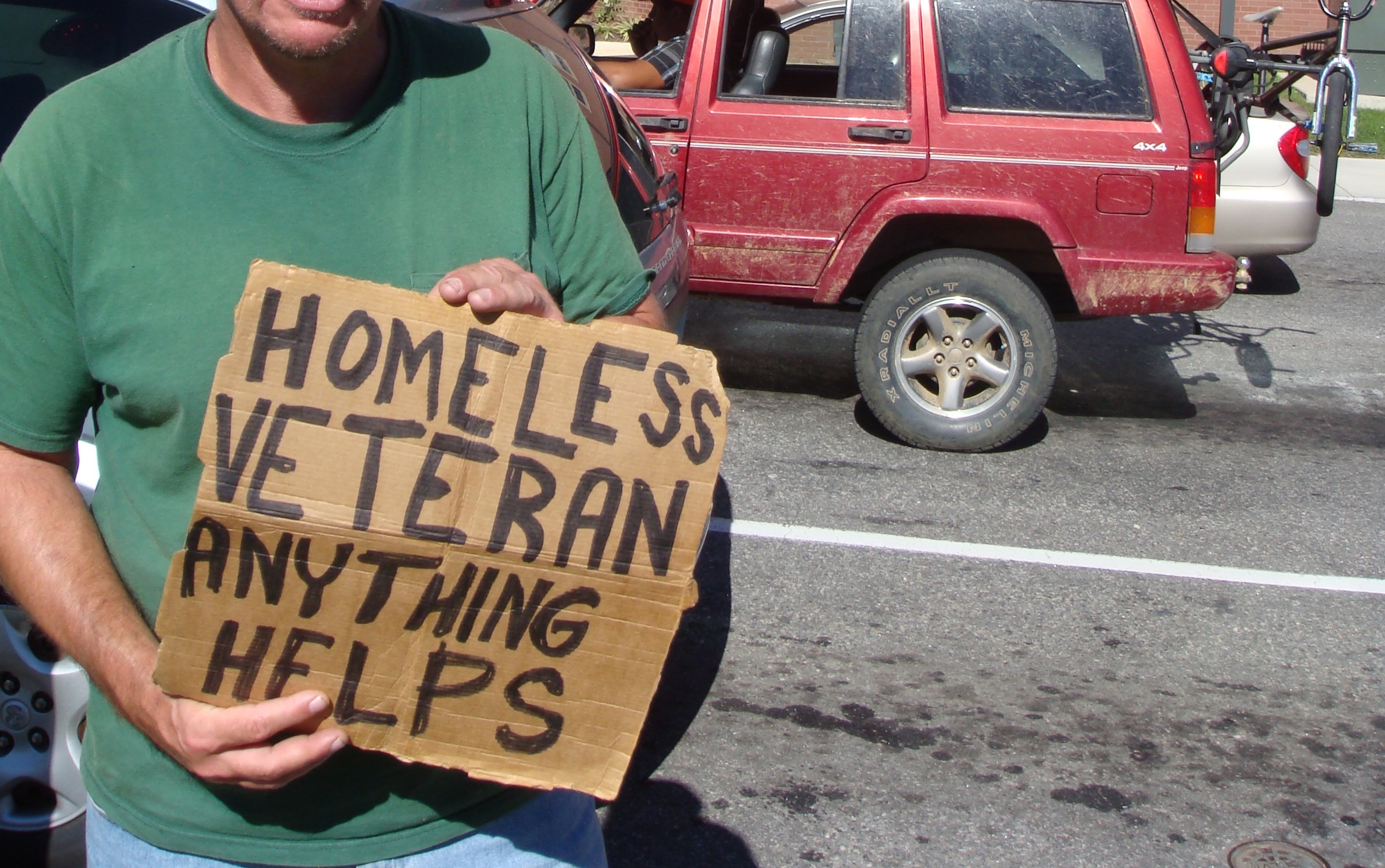
“Nurse Jo!” he yelled as he hopped up on the sidewalk beside me, grinning. On the street corner near us was a middle-aged white man holding a cardboard sign, with large hand-written words: “Homeless Veteran. Anything Helps.” I hadn’t noticed him before. He turned toward us. I saw it was James,* another former Street Center clinic patient of mine. He and Bruce were longtime friends, both were Viet Nam vets, and both were River Rats.

I talked with them for a while, imagining this was all part of a bad Southern Gothic version of a Woody Allen movie script. Bruce told me he had tried to drink himself to death but it hadn’t worked. The VA doctors were good and they were taking better care of him than they used to. He had a room in a house in Oregon Hill and had managed to stay there most of the time over the past ten years. He never got the trailer home he’d wished for. He’d cut back on his drinking and his blood pressure was better. The two men gleefully compared blood pressure readings, trying to impress me. Nurses are supposed to like that sort of thing. James had been living in Florida for a while and had just hitchhiked back to Richmond the day before. He was camping down by the river with buddies, with other modern-day River Rats.

“Mad Dog died last month, man. Did you hear Mad Dog died?” Bruce asked James. I didn’t know Mad Dog. While they were making plans to hook up later, I looked past them to the south. I could see cars speeding past us on the Downtown Expressway. Under the Belvidere Street Bridge that crosses the Expressway, I saw a group of four white young adults sleeping on old mattresses. At the top of the hillside above them there was a large hole in the fence, and beyond that was a boarded up house on the edge of what remained of Oregon Hill. The Hollywood Cemetery and Confederate shrines remain. Nothing had changed and everything had changed.

___________________

Take a look at the great (short) documentary video about a Seattle-based play Don Quixote and Sancho Panza: Homeless in Seattle, written by Rose Cano, a  Spanish medical interpreter at Harborview Medical Center Emergency Department. The play is in response to a question she asked herself, “How do people maintain their dignity while being homeless?” As she explains in this video, one of her answers is: through the friendships and ‘street family’ relationships that develop for many people—including for people like Bruce.

* Names and other identifying details of former patients have been changed.

Virginia Relics Part Two: Eugenics

IMG_2662 - Version 2
Skeleton in the Library 2014/Josephine Ensign

Health and Homelessness in Richmond, Virginia in the 1980s: A companion to Virginia’s Racial Integrity law (see previous blog post ‘Virginia Relics Part One: Racism’), The Eugenical Sterilization Act, was also passed into Virginia law in 1924. This was part of Social Darwinism, The Progressive Movement and eugenics: bettering society through social and scientific engineering. Margaret Sanger, the nurse and founder of Planned Parenthood, was part of this movement. The pseudo-science of phrenology–measuring the skull to predict IQ and criminality–was part of eugenics.

Virginia’s Sterilization Act mandated involuntary sterilization of people institutionalized with mental retardation,*  severe mental illness, and epilepsy. It also applied to prison inmates. They were all the defectives or delinquents, viewed as a drain on society–they should be eliminated. People who were institutionalized and considered feeble-minded included the shiftless poor, homeless, runaway teens, chronic inebriates, and oversexed women. Physicians could involuntarily sterilize women of normal intelligence who were deemed promiscuous. Promiscuity was defined as having a baby outside of marriage, having multiple sexual partners, being a white woman with a black partner, or working in prostitution.

When Virginia passed the Sterilization Act, eugenicist physicians looked for a suitable test case to seal it into law. The physician in charge of the Virginia State Colony for Epileptics and Feebleminded found his ideal candidates in three generations of Buck women. The elder and widowed Mrs. Buck had been confined to the Colony for having illegitimate children. One of her daughters, Carrie, had gotten pregnant at age sixteen—the result of rape by a young man in her foster family. A Red Cross nurse declared Carrie’s daughter, Vivian, feebleminded at six months of age. The nurse reported in official expert testimony that Vivian was “peculiar,” with “a look about it that’s not quite normal.” The head of the Virginia Colony wanted to sterilize all three of the Buck women. The case went to the U.S. Supreme Court, where Chief Justice Oliver Wendell Holmes, Jr. likened involuntary sterilization of degenerate offspring to state sanctioned immunizations. The Supreme Court Justices ruled in favor of Virginia, so the Buck women were sterilized—except for Vivian who died at age eight in the care of the same foster family where her mother had been raped.

After the Supreme Court ruling, Virginia physicians aggressively pursued the Sterilization Act, giving Virginia the highest per capita rate of involuntary sterilization of the “feeble-minded” and other undesirables. One of the main Virginia eugenics physicians, Dr. Albert Priddy, wrote to physicians in Nazi Germany praising their work and bemoaning the fact that the U.S. lagged behind the Nazis in the eugenics movement. During the Nuremburg Trials after World War II, defense attorneys for Nazi doctors cited the Buck vs. Bell U.S. Supreme Court ruling as justification for the Nazi doctors’ involuntary sterilization of hundreds of thousands of people. Buck vs. Bell has never been overruled. Virginia’s Eugenical Sterilization Act wasn’t repealed until 1979, just a few years before I started nursing school.

Before my work at the Richmond Street Center, I was vaguely familiar with these parts of Virginia history—of how my home state tried to not only designate and separate the desirables from the undesirables, but also to extinguish the undesirables. Some of the activist social workers at the Daily Planet talked about it. But it was embarrassing, something I preferred not to think about. I was able to avoid thinking about these laws because I viewed them as relics from a past that didn’t affect me. My work at the Street Center–and especially with a patient named Sally**– changed that. Sallie lived with her alcoholic mother in the heart of the all-white and impoverished Oregon Hill, located across Belvidere Street from the Street Center. Sally had an IQ of 45. One day several years into my work at the Street Center, Sally came into our clinic complaining of belly pain. I discovered she was four months pregnant. She was obese and wore baggy clothes, so no one had noticed her expanding belly.

Within the first year of opening, the Street Center had become a popular hangout for Richmond’s marginally housed adults, including many who had mental retardation and mental illness. They moved around to live with different relatives, or they lived in cheap, moldering old downtown hotels. Others lived in Richmond’s numerous group homes. Many of these homes were located less than a mile from the Street Center, a straight shot north up Belvidere Street where it turned into Chamberlayne Avenue. Chamberlayne had huge, stately old brick homes, now abandoned in the White Flight after school desegregation. The houses had been converted into group homes, domestic abuse shelters, a teen runaway shelter, and even an animal shelter. It was a social service ghetto.

Group homes had opened in response to deinstitutionalization efforts in the 1970s and early 1980s, as mentally retarded and chronically mentally ill people were moved out of state-run long term care institutions and back into the community. The idea was a good one: provide supportive home-like living situations and community mental health care. But no one wanted group homes in their neighborhoods, so the homes ended up clustered in low-income areas. Most of the group homes in Richmond were poorly run, inadequately staffed, and lacked licensing oversight. There was also a deficit of community-based mental health and support services for the residents of group homes.

The Street Center social workers tried to be alert for clients like Sally with mental retardation or chronic mental illness and to tie them in with alternative services. These clients were vulnerable to being preyed upon by the street-hardened homeless men in the center. The Street Center had free meals, lax rules, and staff members who were earnest, kind-hearted young people. The building was always bustling with activity, so it was a magnet for people like Sallie.

By the time I discovered her pregnancy, Sally was past the window for being able to have an abortion–even if her deeply religious mother had agreed to one. As a nurse I was required by the state to report suspected child abuse and neglect, which this seemed headed toward. I didn’t like being part of a system that could take children from their parents. I didn’t like being an agent of social control, but I knew I had a duty to protect vulnerable children.

A simultaneous and distasteful part of my job was dealing with the childless, infertile white upper middle class Christian married women who hovered around our clinic in search of suitable babies to adopt. I was a mother by then, so I understood some of what it must feel like to desperately want a baby and not be able to have one. But the childless women would drop off bizarre advertising materials: pages of contact information, written statements, and formal studio photos of them beside their husbands. It felt obscene that they were shopping for babies at the Street Center and taking advantage of an already marginalized population. Since our clinic was run by a conservative Evangelical Christian organization, I allowed the women to leave their advertisements. What the women didn’t say directly but carefully implied was that they only wanted white babies. And they certainly didn’t want to adopt a baby from a white mentally retarded woman like Sally.

* Terms such as “mentally retarded” or “developmentally disabled” I use based on accepted terminology within the U.S. medical and legal realms of the particular time period I am writing about.

** Names and identifying details have been changed, and in this case I have chosen to use a composite patient.

***Resources:


Housing is Health Care

DSC00403
House in Richmond, Virginia 2014/Josephine Ensign

Health and Homelessness in Richmond, Virginia in the 1980s: Although I was intimidated by her when I first started working at the Richmond Street Center in 1986, I quickly came to view Sheila Crowley as a valuable mentor.

Sheila Crowley was the Executive Director of the Daily Planet (the lead agency of the Richmond Street Center) from 1984-1992. She left the Daily Planet in 1992 to work on her doctorate in social work, focusing on housing policy. As part of her doctorate, she did a yearlong housing policy fellowship on Capitol Hill. Since 1998 she has been President and CEO of the National Low Income Housing Coalition (NLIHC), based in Washington, DC. The NLIHC works on socially just national housing policy issues, public education, and research. They publish the annual Housing Wage/ Out of Reach Report, which shows side-by-side comparison of wages and rents for all U.S. counties, metropolitan areas, and states.

In my telephone conversation with Sheila several years ago, she characterized the national policy climate as “a disconnect between the response to homelessness and the response to the housing shortage.” She commented on how homelessness has become institutionalized and taken for granted, with so many more people working within the homelessness industry than when it originated in the 1980s, and with even more displacement of low income people from housing.

I had been thinking about similar things. After more than a quarter of a century working with homeless people in the U.S., it disturbs me that there are more, not less people experiencing homelessness, illness, and lack of access to basic health care. There are more specialized services for homeless people in our country than there were three decades ago: homelessness as a problem has become institutionalized. Within the federal government, the Interagency Council on Homelessness includes representatives from fifteen different federal agencies related to homelessness. Homelessness has become an industry. There are currently at least 1 million people working directly with homeless-focused agencies. Homelessness is an assumed aspect of modern American urban life, often portrayed in Hollywood movies as part of a gritty, authentic urban backdrop. I had been asking myself whether by working in the ‘homelessness industry’ I was doing more harm than good: harm in that I helped make homelessness more palatable to people experiencing homelessness, as well as to our housed community members (and yes, even to myself: a literal “I gave at the office” sort of a thing). I haven’t found an answer to my question, but I continue to think it’s an important one to ask.

Sheila gave me broad-brush characterizations of the Clinton, Bush, and Obama administrations’ approaches to housing and homelessness. Under Clinton there was emphasis placed on de-concentration of low-income housing, with the unintended consequence of a net loss of low-income housing units. The Bush administration placed emphasis on increasing home ownership rates, with some funding going to McKinney Homeless Assistance for housing programs. Obama appointed a great Housing and Urban Development (HUD) director, Shaun Donovan, and Sheila had high hopes, but at the time of our interview she felt that not much had been done. The Homelessness Prevention and Rapid Re-housing Program funded through the American Recovery and Reinvestment Act of 2009 appears to have been effective at preventing the worst of recession-related increase in homelessness, although the numbers of unsheltered and doubled-up homeless increased during the 2009-2011 time period.

Sheila and I talked about how even the term ‘homeless’ is problematic on many levels. In the U.S. there have been different official federal definitions for homeless. Until recently the Department of Housing and Urban Development only included the visible or literal homeless—those living on the streets or in emergency shelters. Other federal definitions, such as those necessary for receiving health benefits, have had broader definitions that included people temporarily doubled-up with friends or family, people living episodically in cheap hotels, and people living in cars or other places not intended for human habitation. This definition encompasses people in many different variations of being marginally or precariously housed—as I had been as a young adult. The HUD definition was amended in December 2011 to be more in line with this broader definition of homeless.

Sheila described being at a Homeless Advocates Group (HAG) national meeting recently. HAG is composed of leaders of all the major groups working on homelessness at the national level, including the NLIHC, the National Health Care for the Homeless Council, and the National Alliance to End Homelessness. She looked around the meeting room and realized that all of the leaders of the represented agencies and coalitions were now in their fifties and sixties and had gotten their start in homelessness work in the 1980s. She thought to herself, “Here we go again,” with the increase in the number of homeless, this time due to the national foreclosure crisis and effects of the prolonged recession.

She was quick to highlight success stories, communities that are pulling together coordinated responses to homelessness with a Housing First emphasis—working to maintain people in adequate affordable housing and to quickly re-house people—and a Housing Plus approach of providing supportive housing for people with mental or physical health or substance abuse issues complicating their homelessness. People cannot be healthy unless they have safe and healthy housing. She mentioned Columbus, Ohio and Worcester, Massachusetts as two examples of successful community responses, and added that my new hometown of Seattle has done pretty well with a significant decrease in the chronically homeless population. Across the country, there’s been resistance from emergency shelter providers and church-sponsored programs who see funding and support moving away from their services. But the Housing First movement has had broad bipartisan support since it cuts across different political ideologies.

When I mentioned to Sheila what now stands at the corner of Belvidere and Canal Streets where the Richmond Street Center had been (it is now a VCU college dorm building and a Starbucks), she immediately said, “The only thing I regret about the Street Center building being torn down was the elevator.” This surprised me until I remembered what a practical woman Sheila is—a common character trait of many of the social workers, as well as of public health nurses I have known. She reminded me that the city inspectors had insisted she fund and install a $30,000 elevator in the Street Center building before it could open. She hopes they were at least able to re-use the elevator for another building. She also recounted the construction of the addition on the back of the Street Center for the expanded clinic space I worked in. A sinkhole opened up in the parking lot while they were preparing the foundation. That’s when they discovered that the Street Center was built on land that had been the city dump. Sheila said she went back to where the workmen were standing around looking at the hole, rubbing their chins, exclaiming, “It’s the darndest thing,” and she responded, “Well don’t just stand there, do something about it!”

We need more people like Sheila who don’t just stand around contemplating problems, but who roll up their sleeves and try to solve them.

**Resources:

The Daily Planet

381938823_9c01f8921d_zHealth and Homelessness in Richmond, Virginia in the 1980s: Although I wasn’t sure anyone would come to the clinic at the Richmond Street Center when it first opened (in May 1986), within the first month I had seen fifty different patients for eighty-one clinic visits–meaning patients were returning to the clinic for follow-up visits. After the second month I had seen one hundred nineteen patients for two hundred and fifty visits, and so it grew, all out of the one-room clinic. By the end of the first year of operation, I had seen over sixteen hundred patients for close to four thousand visits. I didn’t need to exaggerate the numbers of people I was seeing. I was treating everyone from newborn babies and their moms, to homeless men in their seventies. The majority of patients were homeless single men in their late twenties who had injuries and skin infections from life on the streets.

Many of the clinic patients were young African-American men from Richmond who had burned bridges with family and ended up on the streets. The crack cocaine epidemic was beginning to reach Richmond from Washington, DC and Baltimore, bringing with it a rising murder rate. Its violence would soon spill over into the Street Center. Some of my patients were not strictly homeless. They were adults with stable chronic mental illness or marginally functional developmental delay, then called mental retardation, who lived in supervised group homes nearby. They moved in and out of homelessness.

The lead agency of the Richmond Street Center was the Daily Planet:  a drug, alcohol, and mental health service agency with its roots in the 1960s counterculture. The Daily Planet social workers got their start by counseling young people coming down off bad trips from street drugs. There were many such young people around the near-by Monroe Park campus of Virginia Commonwealth University. The Daily Planet took its name from Clark Kent’s newspaper of comic book fame; drug-tripping clients (or ‘consumers’ as they called them) said they came out of phone booths after talking with agency staff, and they felt like Superman.

Sheila Crowley, the head of The Daily Planet, repeated this story often, followed by a rumbling laugh. She was tough, staunchly feminist, with long wavy hair and over-sized glasses, long sleeved shirts rolled up over her biceps. Sheila looked uncannily like photos I had seen of a young Gloria Steinem. As if she were a scrappy pit bull with a shredded ear I might see loose on the downtown streets, I gave Sheila a wide berth at first. I could easily differentiate the Planet staff from the consumers; their staff members were all like Sheila. The women staff members were white zealous feminists and the men were Deadhead-type hippies. They were not big fans of any organized religion, but they were tolerant of the varieties of Christian do-gooders they now found themselves working with, for the common cause of combating homelessness.

For the first several years of the Street Center Clinic, I was the only health care provider. We had volunteer physicians who came in on Saturday mornings to see the more medically complex patients. I learned to rely on the social workers, activists, and support staff of the Street Center in order to provide the best care we could. In essence, although this preceded development of the concept, we were trying to address the social determinants of health. I worked at the Street Center for four years before moving on to graduate school in Baltimore. It was not an easy transition and I became homeless myself for six months, so I lost touch with most of the people I had worked with.

Several years ago I was curious what had happened to the various community clinics (and their staff members) I had worked with in Richmond back in the 1980s. I met with Peter Prizzio, Chief Executive Director of the Daily Planet. After Sheila Crowley left, the Daily Planet went through some rough patches with leadership. Peter was brought on board in 2002 and modeled the Planet after Baltimore’s excellent Health Care for the Homeless freestanding clinic. The Daily Planet is now the recipient of the Health Care for the Homeless federal grant I helped write in 1987. The Planet is part of the community mental health safety net, such as it is, for Richmond.

The Daily Planet Clinic is currently located on Grace Street four blocks north of where the Street Center had been. Next door to the clinic is the same pizza place parking lot where I first met Dawn (a young prostituted teen who haunts me still) while doing outreach with the Richmond Street Team. When I returned to the area to meet with Peter, I knew I wouldn’t run into Dawn–she had died of AIDS the year I left Richmond.

Peter is a tall, energetic and engaging man, who gave me a tour of the building, and then we sat and talked for an hour. Peter told me The Planet serves around four thousand patients for thirty thousand visits each year. They have an annual budget of $3.5 million, half of which of which is from the Health Care for the Homeless federal grant. The majority of their patients are long-term Virginia residents, while about 15-20% of the patients are more transient, traveling up and down the I-95 corridor between New York, Baltimore, and Florida. The Planet has primary care providers including doctors and nurse practitioners, dentists, and behavioral health (chemical dependency and mental health) specialists.

Peter told me they are not able to get much support from the City of Richmond. He said that City officials tend to refer to the homeless as “your people,” and view homeless people as shiftless, lazy, and a nuisance to downtown businesses. He described a plan that had been developed a few years back to have a central intake system for homeless and uninsured patients in Richmond. Agencies would pool resources so one case manager could follow patients to ensure their health care wouldn’t be as fragmented. The plan never got off the ground because the agencies were fighting each other for scarce funding for their own programs.


Homeless Refuse and Refuge

DSC00479
The James River and Richmond Skyline 2014/Josephine Ensign

Health and Homelessness in Richmond, Virginia in the 1980s: A half-mile south of the Richmond Street Center was the wide James River. Along the riverbanks lived a group of my patients who called themselves the River Rats.

The River Rats consisted of a dozen or so adults, mostly men, with a few women who were married or otherwise attached to the men. The River Rats ranged in age from twenty-six years old, to an older man named Bruce* who said he was fifty-two, but looked much older. Many of the River Rats lived together under a bridge by the river. They were heavy drinkers who enjoyed the relative freedom of living outside on their own. The frat party atmosphere permeated the area. On summer weekends the River Rats drank alongside the young Richmonders who sunbathed on the flat rocks, or inner tubed in the smaller rapids, floating coolers full of beer beside them.

A few of the River Rats rode the rails. They hopped on and off the freight trains passing through Richmond. They were traditional hobos out of a different era. They had been to more parts of the country than most people had in their lifetimes—certainly more than I had been to at the time (I was in my mid-twenties then). Several of them came to me with hand and knee abrasions from tumbling off a moving train and getting scraped up on the gravel railroad track bed. In my second year at the Street Center, one of my regular rail-riding patients was buried alive in an open coal car the morning after he’d celebrated his thirtieth birthday by getting more drunk than usual. His travel partner told me about it the next time he came into the clinic.

Richmond was (and still is) at the cross-roads of two major east coast interstates, I-95 and I-64, as well as of two major freight train lines, so the city got a fair number of people traveling through, hitchhiking or riding the rails or the Greyhound bus, who stopped and got stuck, or stayed for whatever reason. They were like the flotsam caught in swirling eddies of the river.

There was discussion in the two local newspapers about whether the homeless people in Richmond were really from Richmond, or even from Virginia. Many of the newspaper articles featured interviews with homeless people who said they were from Baltimore, or New York City, or Philadelphia. The underlying implication was that many of the homeless people in Richmond were from the North; therefore, they were either invaders, or proof that the large northern cities were dumping their problems on Richmond, taking advantage of Southern hospitality. Richmond was enabling felons, drug addicts, and lazy people who were homeless by choice. They would never be able to be recycled into productive citizens, the articles seemed to say. Newspaper articles were more sympathetic to homeless people in Richmond who reported being from impoverished rural areas of Virginia or North Carolina. Whether they were black or white, they had been dealt a bad hand in life. They were our people and we took care of them.

Homelessness was an urban problem I associated with large, gritty urban areas like New York or Baltimore. I was surprised to see homelessness on such a large scale in my own hometown. The center of Richmond was decaying. Discarded carcasses of old buildings were everywhere. There were buildings with boarded up windows and doors, charred remains of other buildings, people’s belongings dumped in disheveled piles on the sidewalk curbside: evidence of evicted people, now homeless. Driving through the city at night you could catch glimpses of dark darting shadows or muffled flashes of a cigarette lighter, flashlight, or candle in some of the boarded up houses. The shadows were squatters, homeless people—ghosts. Houses that were still legally lived in showed signs of faded beauty. Stone cornices and intricate wooden lattice dangled loosely from front porches.

Along Belvidere Street near the Street Center, two blocks of houses had been razed to make way for expansion of the university. For over a year, to cordon off the construction site from sidewalk and street, the construction crew lined up old doors from the torn down houses. They leaned the doors against temporary chain-link fences anchored by large concrete blocks; this made a long expanse of multicolored doors, which was as beautiful and shocking as a modern art installation. Sitting in my car at a stoplight on my way to and from work, I’d stare at the doors. I marveled at the deeply saturated red doors, wondering what sorts of rooms they had opened into. There were also a few doors that had obviously belonged to children’s bedrooms. They were decorated with brightly colored Disney characters like Donald Duck and Cinderella. I wondered if some of the doors had belonged to patients of mine who were now homeless. And I wondered what it must feel like to be a child and recognize the stickers from your old bedroom door as you were being dragged along the street by the hand toward the emergency shelter.

In stark contrast to the dismantled and rotting parts of the inner city were patches of rebuilding and renovating. The biggest of these was the ill-fated $16 million glass-enclosed Sixth Street Marketplace spanning Broad Street. Built in 1986, the Marketplace was meant to bring back small businesses to the downtown core of Richmond. It failed and was torn down less than twenty years later at a cost of $67 million. Closer to the Street Center was the grand Jefferson Hotel, built with tobacco money after the Civil War. It had been sitting empty for over a decade, although it was occasionally used to film movies or host high school proms. The grand staircase of polished marble was rumored to have been the model for the staircase in Gone With the Wind. My Lee-Davis High School senior prom had been held there as the hotel was closing.

By 1986 they had completed a $34 million dollar renovation of the Jefferson, and the hotel was reopened simultaneously with the opening of the Street Center. The buildings were several blocks apart. Standing in front of the Street Center on Canal Street, the Jefferson loomed over the top of it: pale grey marble against dark brick, majestic rich above outcast poor. At night the tall grey clock tower of the hotel glowed in the floodlights.

* Note: All names and other identifying details of former patients have been changed.

The Richmond Street Center: In My Backyard

Street Center B + W copy
The Richmond Street Center 1986

In May of 1986 I began my first ‘real’ nursing job: I worked as a nurse practitioner at the Cross-Over Health Clinic, located in a multi-service center for homeless people called the Richmond Street Center. Located in downtown Richmond (Virginia), the Street Center housed the clinic, a shelter, soup kitchen, laundry and shower services, and many social workers. The lead agency for the Street Center was the Daily Planet (which I’ll write more about in follow-up blog posts in this series). Working at the Street Center clinic as my first nurse practitioner job was either ambitious or ill conceived, and I often thought it was both on the same day. After a few months working at the Street Center I no longer freaked out when I saw scabies or crabs, gangrene, maggots, or schizophrenia.

The Street Center was thick-walled and cavernous. It was located in the armpit of town, on the border between Monroe Ward, Gamble’s Hill, and Oregon Hill near the James River. Built on land that had been the old city dump, the building had been a gas meter repair shop for the city as well as a storage unit for abandoned bicycles. The city donated the building as a way to appease the downtown merchants who wanted to get the street people—the visible homeless—away from their struggling businesses. Kudzu vines draped over trees and telephone polls; they formed a convenient curtain to block the public’s view of the ugly, forbidding looking building.

The Street Center was located at the corner of Belvidere and Canal Streets, with the main entrance on Canal. The building was flush with the narrow sidewalk.  Belvidere Street, a busy four lane divided highway that ran north to south, was part of US Route 301 extending down to Sarasota, Florida, and up to Delaware. Across Belvidere from the Street Center was a 7-11 that sold cigarettes, cheap beer and flavored wine like Boone’s Farm and Thunderbird, all popular with the Street Center clientele. South of the Street Center were the hulking brick buildings of the Virginia Penitentiary, and just to the west was Hollywood Cemetery where a relative of mine—Jefferson Davis—and 20,000 confederate soldiers lay buried. In the block north of our building was a Hostess Twinkie factory. The sweet buttery smell of the factory mingled with the acrid smells of the Street Center: damp oil-stained concrete, souring unwashed bodies, old urine, and cigarette smoke.

When the Street Center opened in April 1986, homelessness was getting extensive national and local attention, with almost daily newspaper and TV news coverage. In May of that year, USA for Africa teamed up with Coca-Cola to sponsor Hands Across America to raise money for “fighting hunger and homelessness.” They had thousands of people hold hands for 15 minutes in cities across the nation. President Reagan joined in the hand holding from the White House, reportedly shamed into doing it by his daughter. There was a sense that homelessness—at least this new version of homelessness—could be cured.

As a group, people who were homeless were called street people; they were poverty made visible on the streets and sidewalks. Homeless people, mostly in the form of older alcoholic men, had been part of the American urban scene for a long time. They had been called vagrants, paupers, hobos, and bums. What was new was a combination of the sheer number of homeless people, along with the changing face of homelessness. There were now women, younger people, and entire families living on the streets.

Homelessness was portrayed as a national disgrace, and the urban housing market crisis and government inaction were mostly to blame. People talked about upstream measures and prevention of homelessness, but in a fuzzy idealistic way such as ending poverty and increasing housing. There was frequent mention of deinstitutionalization, the effort to get mentally ill and developmentally disabled adults out of long-term mental hospitals and back out into the community. This was a laudable idea stemming from the 1960’s Civil Rights era, but one that hadn’t worked out so well. Many of the people who had been in institutions needed permanent supervised housing and on-site help with counseling and medication. That combination was scarce to non-existent, and the services that did exist were underfunded and understaffed. Rising numbers of Vietnam vets who had untreated post-traumatic stress disorder, or who had gotten hooked on heroin or alcohol while in the army, were now homeless. Most were men in their early 30’s, at the time of their lives when they should have been settling down and raising a family, but they had been left behind.

All of us service providers at the Street Center believed in our grand cause. Homeless advocates pointed out that homelessness wasn’t as big a problem in Richmond as it was in large cities such as New York, and that if our community acted fast enough we could prevent it from getting out of control. We had a barely murmured, mostly unspoken code of talking up the numbers of the homeless we were serving, while simultaneously talking down any individual vulnerabilities of homeless people, vulnerabilities such as mental illness and substance abuse. We feared that would fuel a backlash of public sentiment against homeless people. We had a vested interest in sustaining the funding for our agencies, for the homeless people we were serving, and for our own jobs. We would say we were trying to work ourselves out of a job, but I don’t think any of us actually believed it.

In the 1980’s, during the time I worked with and became homeless, Mark Holmberg, a Richmond Times-Dispatch reporter, wrote articles with provocative titles such as “Homeless by Choice” and “Homelessness as a State of Mind.” He spent a night at a Richmond emergency shelter, interviewed homeless people and homeless advocates who he often characterized as having misdirected passion. In August 2005 when the bulldozers had finally razed the Richmond Street Center building at the corner of Canal and Belvidere Streets, Mr. Holmberg, in an article titled “Memory of Building Lingers, And So Does Homelessness,” wrote: “It was a sort of one-stop shop—driven largely by love and honest concern—that drew people with tough problems into a concentrated knot of dysfunction. (…) Good riddance, old friend.”

Mr. Holmberg echoed what many Richmond residents felt toward the Daily Planet, that it was synonymous with softhearted, wrongheaded homeless advocacy. And for the fifteen years of its existence, the Richmond Street Center was synonymous with the Daily Planet. Part of me agrees with this assessment, and I see that I was one of those softhearted, wrongheaded homeless advocates. But I’m glad I was. I still believe it’s better than becoming the hardhearted alternative. Even though I didn’t rely on homeless advocates or their services when I experienced homelessness myself, the knowledge that they were there helped me survive and move on.

The dark, hulking 1920’s era three-story brick building on Canal Street that housed the Richmond Street Center was owned by the City of Richmond. Beginning in 1985, the City leased the building to the Street Center’s lead agency, the Daily Planet, for $10 a year. In 1993 the city agreed to sell the property to the Ethyl Corporation, who offered to pay $300,000 to re-locate the Daily Planet. But no suitable site was located in time, mainly because no one in Richmond wanted the Daily Planet consumers in their neighborhood. Ethyl backed out of the agreement in 1995 and concentrated instead on purchasing the land where the Virginia State Penitentiary had stood for two hundred years. Meanwhile, an anonymous donor offered $2 million for the Daily Planet to move its services away from the downtown business core, preferably into Shockoe Valley next to the Richmond City Jail. The Daily Planet Board of Directors declined the offer. In early 2000 the Daily Planet moved four blocks north to its current Grace Street Location. Four years later the City Council sold the now abandoned and boarded up Canal Street property to the Virginia Commonwealth University for $250,000 for them to build student housing and a Starbucks store.

**Note: This is the first blog post of a ten-part series on health and homelessness in my hometown of Richmond, Virginia. The series is based on my work as a nurse providing health care to people marginalized by poverty and homelessness, as well as on research I have conducted over the past few years (e.g.: archival research, site visits, key-informant interviews, and records review). I plan to post a new entry in this series every other day.