Harborview Art Walk and Ekphrasis

P1000172 - Version 2
Harborview Medical Center, Seattle Photo: Josephine Ensign/2015

What do art and poetry and Seattle’s largest public hospital have to do with each other? My colleague, poet Suzanne Edison, and I set out together this week on a mission to find possible answers to that question. We spent a half day doing our own art walk through the lovely and eclectic collection of public art at Harborview Medical Center in downtown Seattle. Then we sat in one of the hospital’s street-side cafes facing the Medic One emergency bays, sipped coffee amidst the occasional swirl of red lights and sirens, and wrote Ekphastic poetry in response to pieces of art that particularly moved us.

Our wonderful King County-based arts and culture organization, 4Culture, has a useful webpage with links showing photographs and describing some of the major pieces of art at Harborview. As they state:

“The Public Art Collection at Harborview has been growing since 1977 and is based on the belief that the arts can counterbalance the emotional, psychological, technological and institutional intensities of the medical center by reducing stress and conveying a sense of individual dignity and worth upon all who enter its doors.”

In choosing the artwork for display in public spaces–busy hallways, specialty clinics, and the numerous waiting room areas–careful consideration is given to things like inclusion of a diversity of artists, artistic styles, and themes. Peggy Weiss, who directs the art program at Harborview, explained to me that they have to try and balance having art pieces be interesting and healing across the wide range of patient populations they serve. (See my previous blog post “A Photo Ode to Harborview” from 1-31-15 for another ‘take’ on Harborview and for photos of its outdoors View Park artwork).

I took photographs of pieces of art and of particular spaces inside and outside the main Harborview (old) hospital, being careful to exclude any people in order to respect patient (and staff and patient family member’s) privacy. Here are some photos of art that I found most engaging and moving:

P1000164
Artist: Dempsey Bob “The Wolf Helper” 1999 cast bronze and horsehair location: atrium in main hospital. Photo: Josephine Ensign/2015.
IMG_3642
Artist: Sultan Mohamed “Royal Family,” 1997 oil on canvas The placard explains that he was inspired by the saying by Ethiopian elders, “Religious beliefs are an individual right but the country belongs to everyone.” Location: in hallway outside entrance to cafeteria Main hospital.
IMG_3616
Artist: Peggy Vanbianchi “Journey: Hands” Mixed Media Location: waiting room of Radiology/outpatient, second floor of main hospital
IMG_3619
Artist: Peggy Vanbianchi “Journey: Journal” mixed media Location: waiting room of Radiology outpatient department second floor of Main hospital.

This piece, ‘Journal,’ with its collection of enigmatic words, such as ‘refuge,’ ‘passage,’ ‘quest,’ ‘search,’ and ‘restore,’ lent itself to our first writing prompt: Take a word from the journal and write from it. I chose ‘refuge’ and wrote a free form poem that took me in surprising directions. The other writing prompts that we came up with were: 1) Write as if two pieces of art are in conversation, 2) Take one piece of art and write from its perspective, and 3) Have a figure in a piece of art be in conversation with the artist.

My main poem that came out of our art walk/Ekphrastic poetry writing day is titled “Harborview Refuge,” and has somehow manifested itself back into its own piece of art of the same name. Using my black and white photographs on various photo transfers (packing tape and acrylic gel medium), along with bits of my poem written on strips of bandage tape, here is my work-in-progress:

IMG_3661 - Version 2

As you can see from these three photographs included in my mixed-media art piece, I am taken by the Art Deco architecture and details of Harborview’s main hospital, which opened in 1931. The almost Gothic gargoyle-looking figure on the right adorns the top of the pillars at the main entrance to the ‘old hospital,’ next to the emergency department.

Harborview Medical center has a tradition of ‘poetry happens.’ Seattle-based writer Wendy Call was a Harborview writer-in-residence in 2010/2011. She worked on a project Harborview Haiku and American Sentences. As part of her project, Wendy shared her poetry with patients and staff and also encouraged them to write their own haiku/American Sentences.

And for anyone who wants to read some recent examples of ekphrastic poetry (and perhaps be inspired to write/submit your own poem in response to a photograph), take a look at Rattle‘s Ekphrasis Challenge.

Ten Neglected Classics of Nursing Literature

IMG_2631Recently, The American Scholar had an article by their editors entitled “Ten Neglected Classics” (1-13-15).  As they state, “…the following books are works we think ought to be read by more people, works that we keep coming back to but aren’t talked about as much as we would like.” This article got me thinking about what books I would include on my list of ‘ten neglected classics of nursing literature.’

I quickly ruled out any and all of the Cherry Ames series. I did not grow up wanting to be a nurse and I never read any of the Cherry Ames nurse series until……okay…true confession: I have never been able to read any of the Cherry Ames books. But I do own one (the photo here is of the cover of the book I own, a 1948 edition of Cherry Ames Cruise Nurse, by Helen Wells). The concluding sentence of the book is the oh so enticing cliffhanger: “And somehow  she knew that although the cruise had come to a happy ending, her friendship with young Dr. Monroe had only just begun.” Someone should write a modern-day feminist kick-ass version of Cherry Ames , or perhaps a lesbian soft-porn version….. But I digress.

Any list of classics, including my list of Top Ten Neglected Classics of Nursing Literature, is highly subjective. Here are my inclusion criteria: 1) about nursing or have a strong lead character–or a strong and memorable character– who is a nurse; 2) books or at least novella-length works; 3) books/works I have read and have in my personal library to refer back to frequently; 4) are still in print/easily accessible; 5) be well-written enough and of wide enough appeal (as in not in a nursing ghetto) to be called literature; 6) not be by or about Florence Nightingale. Oh. I broke that last rule. The term ‘classics’ is also highly subjective, and I include books that have already stood the test of time, as well as more recent books that I believe will stand the test of time.

Here they are:

1) One Flew Over the Cuckoo’s Nest by Ken Kesey. Includes the legendary character of Nurse Ratched. I’ve written about her in a previous blog post ‘Nurse Ratched’s Backstory’ (7-16-13). I love Nurse Ratched.

2) God’s Hotel by Victoria Sweet. Even though this book is mainly about physicians and hospitals, it also includes strong and memorable nursing figures, such as the hospital matron who knitted blankets for her patients.

3) Call the Midwife: A Memoir of Birth, Joy, and Hard Times by Jennifer Worth. There are three book in this series but the first is by far the best.

4) The Beautiful Unbroken: One Nurse’s Life by Mary Jane Nealon.

5) Critical Care: A New Nurse Faces Death, Life, and Everything in Between by Theresa Brown.

6) I Wasn’t Strong Like This When I Started Out: True Stories of Becoming a Nurse, edited by Lee Gutkind. Note: even though I have an essay included in this anthology, I do not receive any payment from sales of the book.

7) On Being Ill by Virginia Woolf along with Notes From Sick Rooms by (Virginia’s mother who was also a nurse) Julia Stephen.

8) Eminent Victorians (chapter on Florence Nightingale is hilarious and enlightening about this complex person) by Lytton Strachey.

9) Between the Heartbeats: Poetry and Prose by Nurses, edited by Cortney Davis and Judy Schaefer.

10) _______________________ I racked my brain and tore up my bookshelves in search of a tenth book worthy of being included in my list, but I have yet to find one. Please add your recommendations/nominations.

When Words Were Poems

IMG_3604-a

Photo: (c) Lorraine Healy–an amazing Argentinian poet, writer, and photographer living and working on Whidby Island. Lorraine is the first person ever to have received a Green Card in the U.S. on the basis of being a poet.

I had the great pleasure of meeting, working, and living with Lorraine recently at Hedgebrook, a Gloria Steinem-spirited place of ‘Women Authoring Change.’ I was at Hedgebrook working on my Soul Stories collection of poetry and prose exploring the boundaries of narrative within health and healing in the context of trauma and homelessness. Surrounded by poets and the genius loci of Whidby Island (including of Double Bluff beach in the photo–where I walked almost every day), as well as being cut off from the time/mind suck of the internet, ‘poetry happened’ and this is one poem that came to me. It is, of course, a nod to Ralph Waldo Emerson’s “Every word was once a poem.” In the poem I probe the places ‘where narrative ends’ or ‘where narrative is not possible.’

There are human experiences beyond the reach of narrative. These are dimensions of experience that are what psychologist Donnel Stern calls ‘implicit knowing’ or the ‘unthought known’: they are there but not there; there but not available for reflective thought or verbalization. Yet these experiences of implicit knowing can be formulated, conveyed, shared and communicated through metaphor, poetry, art, photography, and gesture.

Embracing the times and places where narrative ends and poetry happens is not for the faint-of-heart. It is akin to the feeling of standing on the vanishing strip of shifting sand at the foot of a fast-eroding beach bluff.

When Words Were Poems (a choka–a form of waka/Japanese poetry)

When words were poems

our body’s understanding

was written in flesh;

a repose, a prayer whispered

in answer to awe.

Round marbled babbles sang praise,

danced the sun on waves.

Now each word is a poem,

draw knowledge softer,

suckle life from all splinters,

embrace shadows beyond words.

Narrative Medicine Collection

product_thumbnail.phpHere are a few of my current favorite narrative medicine/medical humanities things:

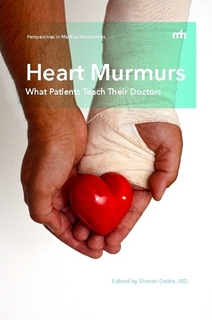
  • Heart Murmurs: What Patients Teach Their Doctors (UC Medical Humanities Press, 2014). This new collection of personal narratives by physicians, edited by my colleague Sharon Dobie, MD, a family medicine doctor who teaches and practices relationship centered care. In these essays Dr. Dobie and thirty-five other physicians explore lessons they’ve learned from patients.
  • Those whacky and wonderful Brits have a much better health care system than we do, and they have this wonderful new (creative) collection (is it a book? is it a collage?) on medical humanities. Published by the Wellcome Collection, Where Does It Hurt? The New World of the Medical Humanities is both entertaining and thought-provoking. (While you’re at it, spend some time browsing their website for fun quizzes, interactive educational games, videos, and more). Here’s what they say abut the book:
    “What does it mean to be well? Or ill? And who, apart from you, really knows which is which? Contemporary definitions of medicine and clinical practice occupy just one small corner of a vast field of beliefs, superstitions, cultures and practices across which human beings have always roamed in the search to keep themselves, and others, feeling well.The label ‘medical humanities’ is the best effort we’ve made so far to define the fence that encloses that very large field; recognising that it’s a space in which artists, poets, historians, film-makers, comedians and cartoonists – in fact every one of us – has as much right to explore as any humanities-schooled or clinically trained professional. This book is a walk through that field, a celebration of its rich diversity, a dip into some of the conversations that are going on within it, an attempt to get it in perspective – and an invitation to you to join the conversation yourself.”
  • The always friendly folks in the middle of cornfields in Iowa (University of Iowa) put on a terrific annual narrative medicine conference: The Examined Life Conference. They just announced that a keynote speaker for their upcoming conference (April 16-18, 2015) is poet Jimmy Santiago Baca. His memoir A Place To Stand (Grove Press, 2002) was made into a documentary released last month.

Speak Art: Poetry Happens

DSC01481 - Version 2

What poetry does: inspires, transforms, moves, agitates, articulates, imagines, disturbs, delights, and mystifies.

What poetry does (according to Emily Dickinson): “If I read a book (and) it makes my whole body so cold no fire can ever warm me I know that is poetry. If I feel physically as if the top of my head were taken off, I know that is poetry.”

Poetry happens. All around us. Every day. Even if we aren’t fully aware of the fact, the muses are whispering subliminal sweet everythings in our ears.

Poetry needlessly intimidates; poetry is relegated to the shelf labeled ‘inaccessible.’ At least that is the case for most adults; children seem to be born poets and we educate them out of it. Goodnight Moon, along with most other popular children’s books, are really illustrated poems.

Along with Cicero so long ago, pragmatic people proclaim that poetry and art are dead. Not true.

I love poetry and have been a mostly closeted writer of poetry. My first (and so far, my only) published poem at age nine (in my elementary school newspaper) was a haiku: “A hurt cricket limps/helplessly and hopelessly/into the forest.” At the time, I wanted to be an entomologist, or a veterinarian, or a writer. I most definitely did not want to be a nurse, but when I re-read this haiku, I see the empathy and compassion that later led me to nursing. Several years ago when my mother was dying of cancer and in home hospice, I found that I could only read poetry. Poetry has a magical quality.

I use poetry in my teaching. For nursing students, I’ve found that it helps to use a healthy dose of poems written by nurses. They resonate more closely for the students, and also make poetry less frightening to students who equate poetry with totally inaccessible, frustrating writing. For instance, I often use the powerful poem by Cortney Davis, “I Want to Work in a Hospital” “where it’s okay/to climb in bed with patients/and hold them—” to spark a discussion on empathy and the murky realms of professional boundaries and burnout. I love the moment in class when I read that opening line, hear a dampening of background noise, and look out over the sea of faces suddenly fully attentive. Poetry is magic.

I use poetry writing in my teaching, but I often sneak this in by not announcing it as poetry writing. For many years, in my health policy undergraduate course, I had students write an American Sentence of their take-home message for that class session. (See my previous blog post “Nurses and Writing the American–Healthcare–Sentence.”) An American Sentence is an ‘Americanized’ version of haiku and is a sentence consisting of 17 syllables. With a class of 150 students, this assignment did double or triple duty: it reinforced their in-class learning of concepts; it forced them to focus and hone their writing skills, and it helped me to read all of their writing before the next class session. Here are a few of my favorite student American Sentences about health policy: “US healthcare: purposeful opacity in service to the rich.” and “Sticks and stones will break our bones, but prevention is the way to stop it #nopoetryskills.” OK, so obviously the student who wrote that last one had figured out the poetry part. Good use of humor and Twitter.

In the final class session of the narrative medicine course I taught this summer, I had the students write either a haiku or an American Sentence to sum up their overall take-home message from the course. Here are some they came up with in 10 minutes of writing time: “Words, poems, artwork/Express the unspoken pain/We need to release.” “Prompted to write, to my surprise, the narrative created healing.” “So close yet so far/More questions raised than answered/ Curiosity.” “Healing is an art/in this class/that is what I get.” (This last one is technically a Lune/American Haiku, but I like it.)

I continue to search for ways to sneak more poetry into not only my teaching, but also into my writing life and into my life. The photograph here is from the Te Papa Museum, New Zealand’s amazingly wonderful national museum in Wellington. They had a ‘make a poem’ board with those little magnetized words in both Maroi and English that adults and children could play with and change around into ephemeral poetry: word art (or toi kupu, which I think literally translates to ‘speak art’–lovely!). When I was there this past February I stopped and wrote a poem mixing English and Maori words, using the Maori words by instinct since I don’t know more than a few words of Maori. Here’s what I came up with (translated into English, and I suppose this counts as my second published poem. Move over hurt cricket!) Poetry happens; let it happen to you.

River understood

travel as divide.

The land

they silence—cold

forged heat.

Pleiades mourns.

Narrative Medicine “Closer” Close Reading In Practice

1384151134Over the past several weeks, in the narrative medicine (NM)  summer course I am teaching, we have been using the ‘closer’ NM close reading approach that I proposed in my last blog post: focusing on the elements of emotion, silence, surprise, and metaphor/imagery. I’ve also asked the students for written feedback on what it is like to use this closer reading technique, as well as how they envision incorporating what they learn from it into their practice as health care providers.

The course is offered through the innovative School of Interdisciplinary Arts and Sciences at the University of Washington, Bothell Campus. The majority of the forty students in my course are nurses, most with Associate Degree preparation, who are now in their BSN completion program (finishing the equivalent of a four-year undergraduate degree program). It is a very diverse class in terms of age, gender, country of origin, ethnicity, race, years of work experience within health care, etc. Earlier in the quarter they all read/learned/practiced Charon’s close reading drill for narrative medicine: frame (includes gaps/silences), form (includes metaphor/imagery), time, plot, desire.

For in-class practice of the closer NM close reading approach, I used various poems from Between the Heartbeats: Poetry and Prose By Nurses, edited by Courtney Davis and Judy Schaefer (U of Iowa Press, 1995). “Burnt-out Offerings” by Sandra Smith with the stanza “We have become/those old crusty nurses/we used to pity and avoid.”–and Courtney Davis’ haunting “The Nurse’s Pockets” both resonated strongly with the students. I also used Kelly Siever’s more nuanced “Breath” and “Between the Heartbeats.”

Students commented that emotion and surprise in the poems were the easiest and most immediate for them to identify, and that metaphor and silence “…need more digging to discover and are more challenging.” Many of the students said that silence was something they had not considered before, that they found it intriguing but difficult. Overall, students felt this NM ‘closer’ reading approach was less technical, “less reserved and detached,” and that it “comes more easily and is something I can see myself using in practice.” One student wrote: “I can see this being used with patient interactions. Taking time to asses one’s reaction to a patient statement or story can prompt further questions, clarify biases, and create deeper understanding.”

I’m still refining how I teach this closer NM close reading approach, and especially how to guide students in how to listen for the silences, for whose voices and perspectives are heard and whose aren’t, and why.


A Narrative Medicine “Closer” Close Reading Drill

DSC00673In the narrative medicine course I teach at the University of Washington I have been using Rita Charon’s narrative medicine close reading drill (as described in her chapter “Close Reading” from her book Narrative Medicine: Honoring the Stories of Illness, Oxford University Press, 2006). I was taught this  narrative medicine close reading drill in the workshops I have taken with Dr. Charon at Columbia University.

As she writes in the opening of her chapter on close reading, “Narrative medicine makes the case that narrative training in reading and writing contributes to clinical effectiveness. By developing narrative competence, we have argued, health care professionals can become more attentive to patients, more attuned to patients’ experiences, more reflective in their own practice, and more accurate in interpreting the stories patients tell of illness” (pg 107).

I was first introduced to narrative medicine in the fall of 2010 when I took the Narrative Medicine ‘101’ workshop at Columbia University. I wrote two reflective (and in retrospect, rather cheeky yet truthful) blog posts about my experience: “The Cult of Narrative Medicine” and “Postpartum Narrative Medicine.”  I stumbled into narrative medicine through my mid-life existential crisis of questioning the meaning of all my striving in terms of clinical practice and teaching nursing–and by practicing the mid-life crisis ‘cure’ by doing the Jungian thing of returning to my adolescent passion of reading (and writing). Then, using the crystal ball of Google searches, I discovered Rita Charon and narrative medicine.

That is the backstory. What I want to highlight in this blog post is my continual nagging–no niggling–suspicion that something is just not right with Rita Charon’s narrative medicine close reading drill. It has taken me years to be able to articulate what bothers me about her drill. I find that it is too cold, cerebral, intellectual; to practice it somehow further objectifies the ‘patient’ and holds them at arm’s length in order to dissect and measure. I have come to that conclusion by applying it to my own clinical practice as well as to my teaching of health professional students.

While trying to practice a ‘close reading’ of an actual patient and his or her story, I kept returning to the lesson of the Test Your Awareness video: “It’s easy to miss something you’re not looking for.” I became so wrapped up in noticing the minute details of what the patient was saying, that I missed the gestalt of the person telling the story. I also missed the fact that I was in a (professional) relationship with this person, that I was an active participant in the clinical encounter, and that I was being affected emotionally by this encounter: their story was ‘reading me.’  And in using this narrative medicine close reading drill with health professions students, I have found that they get all hung up with their anxieties over ‘doing this drill thing correctly’ as though I’m testing them on pathophysiology. (This applies to medical students who one would think have had a more liberal arts education, as well as to more ‘technical college’ nurses who have not likely had university-level courses). None of this can be viewed as ‘humanizing’ the practice of medicine.

What I find most compelling in narrative medicine or medical humanities more broadly, is the application of reflective (and reflexive, self-reflective, but not the ‘bathetic trip to nowhere of importance,’ sentimental, navel gazing variety) practice for health care professionals. My colleague, family medicine physician, teacher,  and writer Sharon Dobie has written about this in terms of the importance of self-awareness and mindful practice in relationship-centered health care (“Reflection on a well-traveled path: self-awareness, mindful practice, and relationship-centered care as foundations for medical education” Academic Medicine vol 82, issue 4, 2007, pp422-427).

I’m still in the process of refining my approach to ‘teaching narrative medicine,’ but here is my alternative to Rita Charon’s narrative close reading drill. My closer (to home) close reading drill:

  • Emotion: What do you feel while reading this (or while listening to this patient illness narrative)? What is the overall mood or emotional effect of the piece? And why do you think it evokes this particular response for you?
  • Surprise: What stands out to you the most? What is unexpected?  This is like Roland Barthes’ term ‘punctum’ in Camera Lucida, or as Arthur Frank puts it “what distracts you but is not the focus of the narrative.” (from a narrative analysis workshop I took with him at a qualitative research conference in Banff, Canada years ago).
  • Silence. What is unsaid in this? Whose voices or perspectives are included and whose are left out?
  • Metaphor (and it’s close cousin simile). The use of imagery and the poetics of the piece.

That’s it. The most important components of a narrative medicine ‘close reading.’ The next time I teach a narrative medicine course, I plan to use these as a close reading guide.


The Problem(s) With Narrative Medicine

booksNarrative medicine is growing in popularity in academic medical centers and healthcare settings. Developed over the past decade by physician and literary scholar Rita Charon and colleagues at Columbia University, narrative medicine (as defined by Charon), “fortifies clinical practice with the narrative competence to recognize, absorb, metabolize, interpret, and be moved by the stories of illness.” There are textbooks on narrative medicine (such as the one by Charon shown here), workshops, undergraduate courses, and masters degree programs in narrative medicine (the Program in Narrative Medicine at Columbia University), and even the venerable Modern Language Association is considering establishing a new forum related to narrative medicine (to be called Medical Humanities and Health Studies). I love narrative medicine and I teach narrative medicine, but I don’t love/teach it without having some serious questions and reservations about this whole ‘movement’ or religion as it sometimes seems to be.

Current narrative medicine discourse assumes an ideal encounter between an empathic physician and a cognitively intact, compliant adult patient. What does this mean for providers or for patients who fall outside these parameters? What does it mean for people excluded from health care? What does it mean to be attuned to the narratives, not only of individual patients, but also to the larger, often silenced metanarratives (grand narratives or ‘big granddaddies of stories’) of power and exclusion?

In its current form, narrative medicine allows little room for critical reflection or exploration of larger structural inequities and structural violence within health care, including those from the medical gaze (a term from Foucault to describe how modern medicine often treats patients as just a physical body, instead of treating the person who is ill or injured). Narrative medicine largely ignores the limits of narrative, especially within the contexts of trauma, suffering, and oppression. What I mean by this last statement is that there are times when people have experiences that don’t fit neatly into a story-line, a narrative of what happened. There are human experiences beyond narrative, and this is where poetry/metaphor and gesture can be more effective means of  personal meaning-making and communication. This is where Arthur Frank’s chaos stories can occur.

Even within narrative, we often have a rigid, scripted notion of what a good, straight, linear, satisfying (and effective) story arc should be. It is usually the hero slaying demons and dragons of some sort, having a nice masculine climax, and emerging at the end triumphant and transformed–and even stronger and more handsome! We want soft-focus lens Hallmark moments that make us feel all warm and cozy inside. As applied to the treatment of cancer, Barbara Ehrenreich’s hilarious yet disturbing essay “Welcome to Cancerland” (Harper’s Magazine, November 2001) is a terrific take on this topic.

I’ve been thinking about these problems recently in regards to my work with narrative advocacy/ policy narrative, and to my teaching of narrative medicine to nursing and other health professions students. Over the next month or so I’ll be writing a series of posts exploring ways to ‘do’ narrative medicine and narrative advocacy differently. I’ll also include a list of resources that I’ve found to be helpful.

The first resource I’ll make a pitch for is the work on narrative humility by physician and writer (and faculty member at Columbia’s Program in Narrative Medicine) Sayantani DasGupta. She recently wrote a brief essay, “Narrative Medicine, Narrative Humility: Listening to the Streams of Stories” for the journal Creative Nonfiction (Summer 2014). In her essay, DasGupta describes her work in narrative medicine as teaching people to listen,  “…(but) what I’m ultimately interested in is teaching people to listen critically, to listen in socially just ways. I want to teach healthcare providers to listen not only to comfortable stories, or stories of folks who are just like them, but also stories that challenge them, stories that are from the margins, stories that are traditionally silenced.”

Hear Hear!!

When Is It OK to Write About Patients?

DSC01479I write about patients; I ask my students to write about patients. I do this as part of reflective practice and with the knowledge that it can contribute to humanizing health care for patients, families, and health care providers. But writing about patients has to be done in a respectful way, with adherence to certain ethical and legal guidelines. By now we all know that it is not okay to write about patients in an identifiable way, and certainly not on social media platforms while in a knee-jerk, bleary-eyed state. But when is it okay to write about patients and patient care?

Many physician writers I know adhere to fairly strict personal guidelines to only publish stories about patients with the patient’s permission–preferably written permission. Rita Charon, MD of Columbia University’s Program of Narrative Medicine is a staunch advocate of this patient privacy ‘rule,’ as is my colleague at the University of Washington, Sharon Dobie, MD (see her excellent recent blog post “Writing About Patients”).  Nurse writers who I have talked to about this (like Theresa Brown, RN who writes for the NYT Well blog) point out that hospital hierarchies and power differentials make it much more difficult for nurses to be able to seek patient permission to publish a story about them. The nurse writers also make the case that in many clinical situations, tracking down former patients to seek such approval would itself be a breach of patient privacy under the federal HIPAA (Health Insurance Portability and Accountability Act) rules.

When I write personal narratives for publication I alter some biographical details of patients and change their names in order to protect their identities. I typically don’t change the names of co-workers and friends, and when I do I clearly indicate that in the text. My most recent published essay, “No Place Like Home(less)” (Pulse: Voices from the Heart of Medicine, 5-30-14), was really about me as the ‘patient’ and I purposefully left out names of co-workers since it wouldn’t have added anything (except length) to the essay. I avoid the use of composite patients (merging together details of two or more patients into one) because to me that enters the realm of fiction and I mostly stick to writing non-fiction. One recent exception to this though is my non-fiction/fiction piece “Steps to Footcare” (The Intima: A Journal of Narrative Medicine, February 2014). It was published as fiction because that’s the category I submitted it under. If I were to include it in a print book collection in the future (something I plan to do), I will most likely have it as a non-fiction essay with an explanation of how I crafted the essay.

Here are some current journal submission guidelines pertaining to writing about patients:

Pulse: Voices from the Heart of Medicine, Montefiore Medical Center and Albert Einstein College of Medicine:

Does your piece describe a patient? Pulse–voices from the heart of medicine is committed to protecting a patient’s right to privacy. Ideally, you will obtain written permission from any patient you write about; as an alternative, you must change his or her name and omit or alter other identifying characteristics. A reader should not be able to pinpoint a neighbor, friend or family member as the subject of your writing.”

The Intima: A Journal of Narrative Medicine, Columbia University Program of Narrative Medicine:

“Patient Privacy Notice
The Intima adheres to legal and ethical guidelines in accordance with academic and health community publication standards.  As clinicians, patients, and family members, we feel strongly that patient privacy and confidentiality be maintained at all times.  We simultaneously recognize that narrative power depends on intimate, singular encounters and the sharing of personal accounts in a respectful and safe environment. To maintain these standards, contributors should review the confidentiality guidelines in the Health Information Portability and Accountability Act (HIPAA), with particular attention to the 18 commonly accepted “unique identifiers.” We also encourage contributors to seek permission before submitting patient stories, and to fictionalize or change identifiable information whenever possible and appropriate to maintain patient confidentiality and privacy.”


American Journal of Nursing, Reflections (personal narratives):

“CONFIDENTIALITY Please use fictional names for all persons and institutions in your story. Locations may also have to be disguised.”


Storytelling for Policy Advocacy

PoppyStoryTimeWhen I tell people that my work focuses on narrative advocacy, they mostly look at me funny and ask, “What’s that?” It is a more concise way of saying ‘storytelling for policy advocacy.’

A common definition of narrative is a story with a teller, a listener, a time course, a plot, and a point. Storytelling is as old as campfires and cave-dwelling. (The photo here is of my father telling Appalachian ‘Tall Tale’ stories to his grandchildren). Storytelling is how we learn about our world, about ethical living, about history, about ourselves. Within the healthcare arena patients and family members tell their stories to nurses and doctors and other members of the healthcare team. It is still a truism that something between 80-90% of the information needed to make a correct medical or nursing diagnosis comes from the patient’s history, from their story.

Storytelling and story-listening are not only important at the individual patient level. They are also important at the community and public health level. Stories can be effective ways to educate and persuade the public and lawmakers on a variety of health and policy topics. Storytelling  (pathos) is part of Aristotle’s three essential components of rhetoric: the art of persuasion. The other two components of rhetoric are logic/reasoning/facts (logos) and the credibility of the speaker (ethos).

Several years ago at The Examined Life: Writing and the Art of Medicine Conference at the University of Iowa, I co-led a workshop “Narrative Advocacy: Writing Lives, Making Changes.” My co-leaders were Marsha Hurst, PhD, a core faculty member in the Program in Narrative Medicine at Columbia University, and Carol Levine the director of the United Hospital Fund’s Families and Health Care Project in NYC. Here’s the abstract of our workshop, which I still refer back to as my own guide and articulation of what I am passionate about:

“Narrative advocacy is the practice of using narrative competencies to advocate for improvements in care. It involves moving beyond the individual stories, to include the connections made within the wider community, and acting upon common interests in order to effect positive change in clinical care, in institutions of caring, and in health policy. In the U.S. there is a long history of health advocacy built on narratives of lived experience of illness and disability, and more recently, grassroots narrative advocacy has expanded through the use of social media. For health care providers and students in the health sciences, narrative advocacy can be a powerful avenue for engagement in health policy because it connects the unique individual experiences with larger issues. As powerful as narrative advocacy can be to engage and persuade policy-makers, it can and has been misused. It is important to have both knowledge and skills in how and when to use narrative advocacy responsibly and ethically.”

This past week I had the opportunity to participate in an excellent online training “The Role of Narrative in Public Health” sponsored by the Center for Digital Storytelling located in Berkley, California and facilitated by Amy Hill. She gave four reasons personal stories are so powerful: 1) stories are universal and typically follow a familiar structure, 2) stories are intimate and touch the heart in a way facts/figures can’t, 3) stories are honest and aren’t as slick and sensationalized as they often are in journalism, and 4) stories don’t (typically) tell us specifically what to do. The Center for Digital Storytelling uses a participatory media and group process to help people create and share their personal stories. Working in groups makes the individual stories more powerful, and the process can be empowering and healing for the participants.

The Center attends to the ethical practice of digital storytelling (would be the same for any type of narrative/storytelling work I think). They ensure storyteller well-being, use principles of cultural humility, and adhere to a set of guidelines in working with people impacted by trauma. They point out that consent is an ongoing process, that the question of story ownership and of sharing and distribution of the stories should be clearly addressed from the very beginning of the project. Amy showed us several powerful digital stories from their various projects. My favorite was on motherhood and women’s rights from their “Silence Speaks” project: Dear Ayhan by Rawan Bondogji. A perfect story for Mother’s Day. It is beautifully done.

Here are some additional narrative advocacy pieces that I use in my teaching: